Hawaiian Feathered Friends Network
Hawaiʻi’s Premier Parrot Rescue · Education · Community Support · Parrot Club Organization
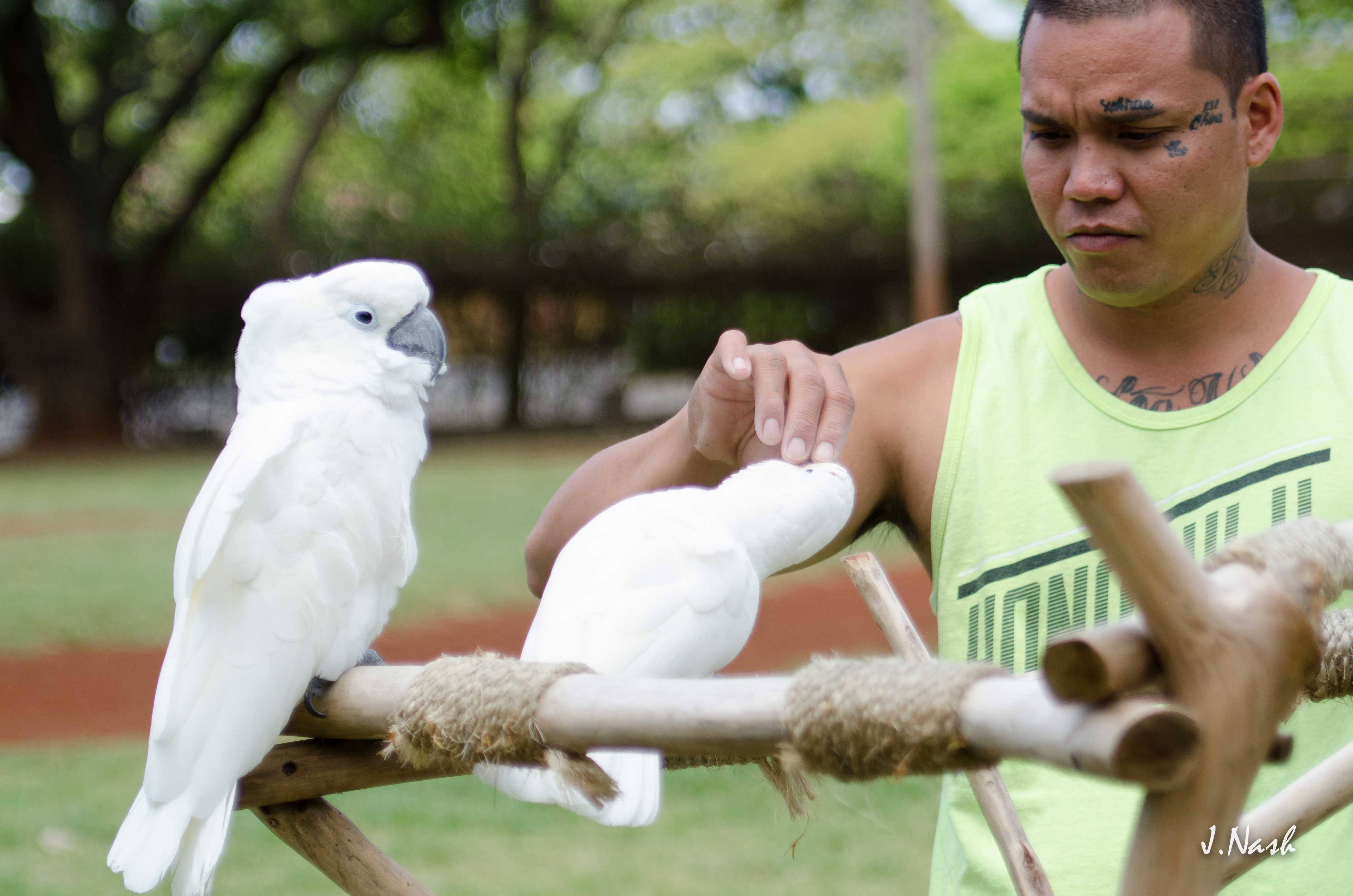
Behavioral & Training Every behavior a parrot shows is communication — our job is to listen and respond wisely
Parrots are not defiant, spiteful, or manipulative — they are highly intelligent animals responding to their environment in the only ways available to them. Understanding behavior from the bird’s perspective transforms the entire relationship.
Understanding Parrot Behavior
Before any training can be effective, it helps to understand how parrots experience and interact with their world. Parrots are highly social, long-lived, and cognitively complex animals. They form strong bonds, have genuine emotional lives, and are acutely sensitive to changes in their environment and relationships. They are also prey animals hardwired for vigilance, and they read body language — yours and everyone else’s — with extraordinary precision.
Problematic behaviors — biting, screaming, feather destruction, excessive contact-calling — are never random. They are always communicating something: unmet needs, fear, overstimulation, boredom, illness, or a misunderstanding of what is expected. The first question to ask about any unwanted behavior is not “how do I stop this?” but “what is my bird trying to tell me, and why?”
A parrot biting you is not being aggressive — it is telling you, as clearly as it knows how, that something in this moment is wrong. The bite is the message, not the problem.
Positive Reinforcement: The Only Effective Approach
Modern avian behavioral science is unambiguous: positive reinforcement — rewarding behaviors you want to see more of — is the only training method that builds trust, maintains the human-bird relationship, and produces lasting behavioral change in parrots. Punishment, dominance-based techniques, and aversive methods do not work with parrots and cause significant psychological harm.
Positive reinforcement is simple in principle: when your bird does something you want, something good happens immediately. The bird learns that the behavior produces good outcomes and repeats it. Over time, you can shape increasingly complex behaviors using this basic mechanism.
Core Principles
Essential Behaviors to Teach Every Parrot
These are the foundational behaviors every companion parrot should know — not tricks, but practical skills that make daily life safer and more manageable for both bird and guardian.
Step Up
The step-up — moving from a surface onto a hand or perch on cue — is the most fundamental behavior in companion parrot care. A reliable step-up makes handling, cage exits and returns, veterinary exams, and emergency situations vastly easier. Teach it when the bird is calm and motivated, using small food rewards. Never force a step-up by pushing your hand into the bird’s chest; instead, lure and reward voluntary movement onto your hand.
Step Down
Equally important and often overlooked, the step-down teaches the bird to move from your hand onto a perch or back into the cage on cue. A bird that steps up readily but refuses to step down has learned a behavior imbalance that leads to conflict. Practice both equally.
Targeting
Target training — teaching a bird to touch its beak to a target stick on cue — is one of the most versatile foundation skills in parrot training. Once learned, targeting can be used to guide movement, teach new behaviors, redirect unwanted ones, and make veterinary procedures less stressful. It is typically the first formal behavior taught and the gateway to everything else.
Recall
A reliable recall — coming to you when called — is a safety behavior that can prevent tragedy if a bird escapes or is startled into flight. It should be taught early and practiced regularly, both indoors and in controlled outdoor settings if the bird is flighted or harness-trained. See our Harness Training page for outdoor recall work.
Cage Entry on Cue
Returning to the cage willingly is a behavior many guardians never formally teach — and then struggle with daily. A bird that has learned to enter its cage on cue for a reliable reward makes the end of out-of-cage time calm and conflict-free. Never chase a bird into its cage or make cage entry a negative experience; the cage should always be a safe, desirable place.
Carrier Training
Every parrot should be comfortable entering and resting in a travel carrier before they ever need to use one for an emergency or vet visit. Introduce the carrier gradually — leave it in the bird’s environment with treats inside, then work toward the bird entering voluntarily. A bird that has never been in a carrier will be terrified during an already stressful veterinary visit.
Understanding Common Behavior Challenges
Biting
Biting in parrots almost always has a clear cause — the challenge is identifying it. Common triggers include fear, overstimulation, protection of territory or a favored person, hormonal fluctuation, pain or illness, or a learned response to previous handling. The approach is always the same: identify the trigger, stop creating situations that produce biting, and build new positive associations with the triggering context through gradual desensitization.
Never respond to a bite with a sharp shake, a forced hold, or any aversive reaction — this escalates fear and destroys trust. Simply and calmly remove yourself from the situation without drama. Do not reinforce biting by giving the bird what it was asking for (usually to be left alone), but equally, do not punish.
Screaming
Parrots vocalize — this is non-negotiable and should be accepted before acquiring a bird. Contact calls, flock calls at dawn and dusk, and excited vocalizations are normal. Chronic, distress-level screaming is not. It almost always results from one of four causes: a genuine unmet need (attention, stimulation, hunger), a learned behavior that has been accidentally reinforced by human attention, separation anxiety, or an underlying health issue.
The single worst response to screaming is to shout back, rush into the room, or repeatedly interact with the bird while it is screaming — all of these reinforce the behavior powerfully. Instead, wait for a moment of quiet, then immediately reinforce that quiet with calm attention. Over time, quiet becomes more rewarding than screaming.
Feather Destructive Behavior
Feather picking, chewing, and destruction are among the most distressing behaviors a guardian can witness and among the most complex to address. They can be rooted in medical causes, psychological causes, or both — and a veterinary workup should always come first. See our Health & Veterinary Care page for more on this.
Hormonal Behavior
Seasonal hormonal surges — typically in spring and sometimes fall — produce dramatic behavioral changes in many parrots: increased aggression, regurgitation toward favored people, territorial behavior, excessive egg laying in hens, and hypersensitivity to touch. Understanding that these changes are physiological rather than personal helps guardians respond with patience rather than frustration.
Practical management during hormonal periods includes reducing petting to the head and neck only (full-body stroking is hormonally stimulating), removing nest-like objects from the environment, adjusting light exposure (shorter days reduce hormonal triggers), and avoiding roughhousing or overly exciting play.
Hens that lay eggs repeatedly — whether or not a mate is present — are at serious health risk from calcium depletion and the physical toll of repeated laying. Chronic egg laying is a medical issue requiring veterinary intervention, not simply a behavioral one to manage at home. Consult your avian vet promptly if your hen is laying repeatedly.
Regurgitation vs. Vomiting
Social regurgitation — a bird bringing up food and offering it to a favored person — is a sign of deep affection and bonding, not illness. It is distinguished from vomiting by the deliberate, head-bobbing motion and the relatively calm state of the bird. True vomiting, by contrast, is uncontrolled, often projects food outward, and is accompanied by other signs of illness. Know the difference; social regurgitation requires a gentle redirect (don’t let the bird continue), while vomiting requires veterinary attention.
Behavioral Do’s and Don’ts
- Reward behaviors you want immediately and consistently
- End every training session on a success
- Respect your bird’s “no” — if it moves away, honor that
- Observe before acting — understand the context first
- Be consistent across all household members
- Work on behaviors before you desperately need them
- Seek guidance from a certified parrot behavior consultant when stuck
- Rule out medical causes for any sudden behavior change
- Manage the environment to prevent unwanted behaviors
- Celebrate small progress — behavior change takes time
- Punish, shake, scruff, flick, or use any aversive technique
- Respond to screaming with attention or shouting back
- Force physical contact the bird is avoiding
- Assume a behavior is “just stubborn” — look for the cause
- Train when you are frustrated or pressed for time
- Let some people enforce rules others don’t
- Ignore sudden behavior changes — they may signal illness
- Use dominance-based or alpha-roll techniques
- Reinforce biting by giving the bird what it wanted
- Give up — most behavior challenges are solvable with the right approach
Building Trust and a Strong Bond
The relationship between a parrot and its guardian is one of the most remarkable bonds in the animal kingdom — but it is built over time through consistent, respectful interaction, not through possession or dominance. Trust is earned slowly and lost quickly. Every positive interaction is a deposit in an account; every frightening or forced experience is a withdrawal.
For newly acquired birds, or birds rebuilding trust after difficult histories, the foundation is patience. Sit near the bird without demanding interaction. Talk softly and move calmly. Offer food from your hand without requiring the bird to approach. Let the bird set the pace of every encounter. This process cannot be rushed — but it also does not need to be complicated. Simply being present, predictable, and safe is the most powerful thing you can do.
The One-Person Bird Problem
Many parrots develop strong preferences for a single person and become aggressive or difficult with others. This tendency is natural but can be managed proactively with broad socialization from the start. All household members should feed the bird, offer treats, participate in training, and be part of daily interaction — ideally before strong preferences are established. If a bird has already bonded exclusively, gentle desensitization work with the less-favored people, always using positive reinforcement, can gradually expand the circle of trust.
Many birds that come to us in rescue have behavioral challenges rooted in previous mishandling, neglect, or simply in human misunderstanding of normal parrot behavior. With patient, consistent, positive-reinforcement-based care, the vast majority of these birds make remarkable transformations. Behavior is not fixed — it is always a response to circumstances, and circumstances can always be changed.
Learning More About Parrot Behavior
Parrot behavioral science has advanced significantly in recent decades. These are areas worth exploring for any serious parrot guardian:
- Applied Behavior Analysis (ABA) as applied to parrots
- Certified Parrot Behavior Consultants (CPBC)
- The Parrot Society of Australia behavioral resources
- Dr. Susan Friedman’s work on behavior and learning
- Living and Learning with Parrots (LLP) course materials
- The Gabriel Foundation behavioral resources
- BirdTricks training resources
- Barbara Heidenreich’s Good Bird Inc. materials
If you are struggling with a significant behavioral challenge and not making progress, a consultation with a certified parrot behavior consultant — ideally one who uses force-free, positive-reinforcement methods exclusively — is the most efficient path forward.