Hawaiian Feathered Friends Network
Hawaiʻi’s Premier Parrot Rescue · Education · Community Support · Parrot Club Organization
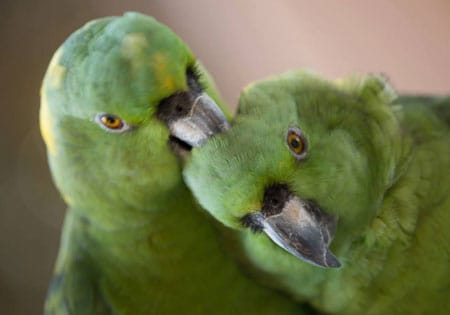
Amazon ParrotGenus Amazona — ~30 species
Bold, opinionated, theatrical, and deeply loving — Amazon parrots are among the most engaging companions in the parrot world. They are also among the most challenging, and they will never let you forget it.
The Life of the Party — On Their Own Terms
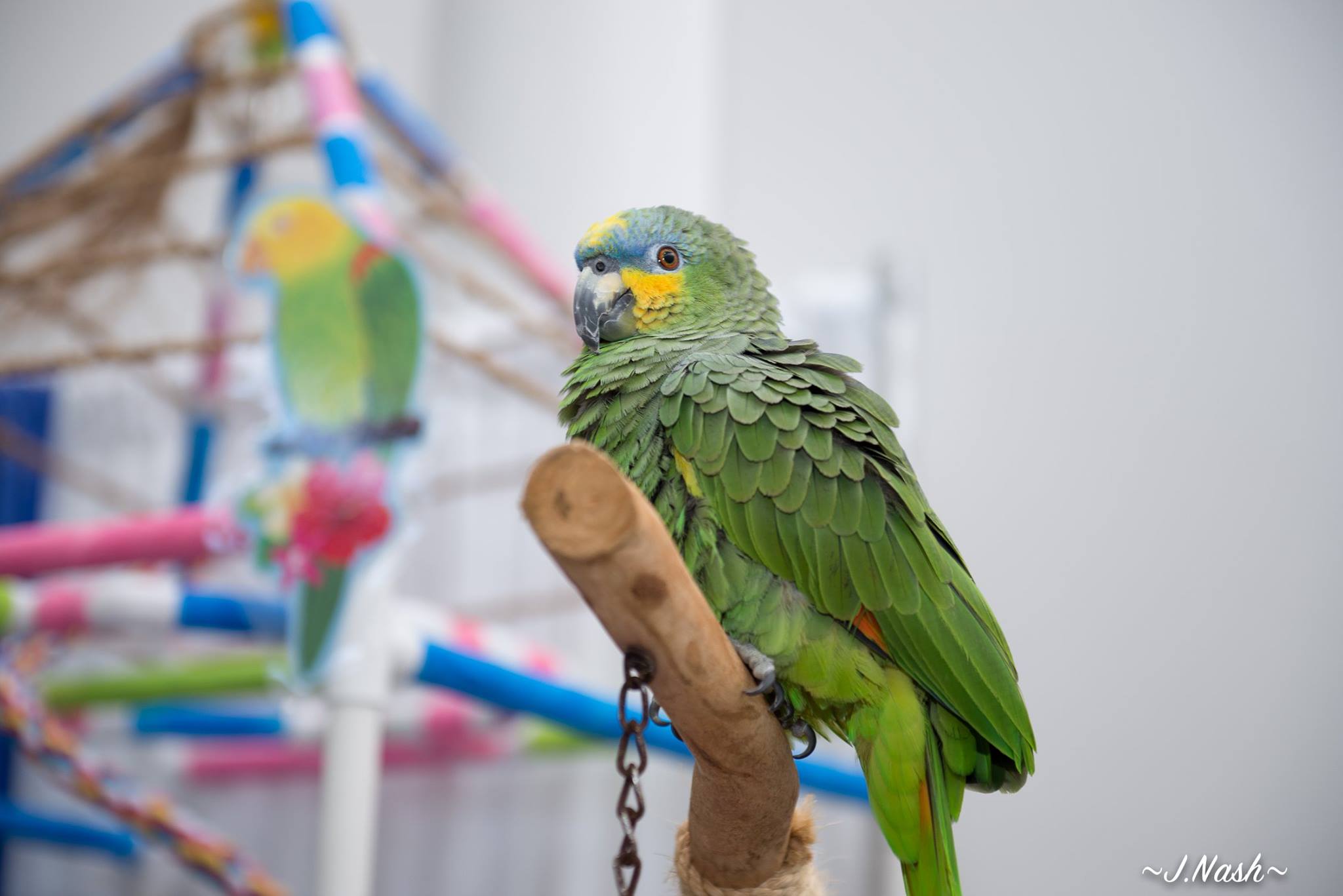
An Amazon at an HFFN member gathering on Oʻahu
Amazon parrots are the common name for members of the genus Amazona — approximately 30 species of medium to large parrots native to the New World, ranging from Mexico through Central and South America and across the Caribbean islands. They are predominantly green, with vivid accenting colors — yellow, red, blue, lilac, or white — that vary by species and make identification both fascinating and occasionally maddening.
In the wild, Amazons inhabit a wide range of environments: tropical and subtropical rainforest, palm groves, savanna woodland, mangrove edges, and scrub forest. They are gregarious, noisy, and highly social birds that move through the canopy in flocks and roost communally. Their wild diet consists primarily of seeds, nuts, fruits, berries, and leafy vegetation.
In captivity, Amazons carry all of that energy with them. They are confident, curious, opinionated, and frequently hilarious. They have strong personalities — some might say oversized ones — and they are not shy about expressing what they want, what they dislike, and how they feel about you in any given moment. For the right person, an Amazon is an extraordinary companion. For the unprepared, they can be genuinely overwhelming.
Amazons have been kept as companion birds for centuries and are among the most widely recognized parrot species in the world. Their combination of intelligence, talking ability, and theatrical personality has made them favorites for generations — and they remain one of the most commonly kept parrot species today, including here in Hawaiʻi.
Amazons Most Often Seen in Hawaiʻi
There are roughly 30 recognized Amazon species. The following are most commonly encountered in Hawaiʻi — either as companion birds with HFFN members or arriving in rescue situations.
Yellow-Naped Amazon
Amazona auropalliata
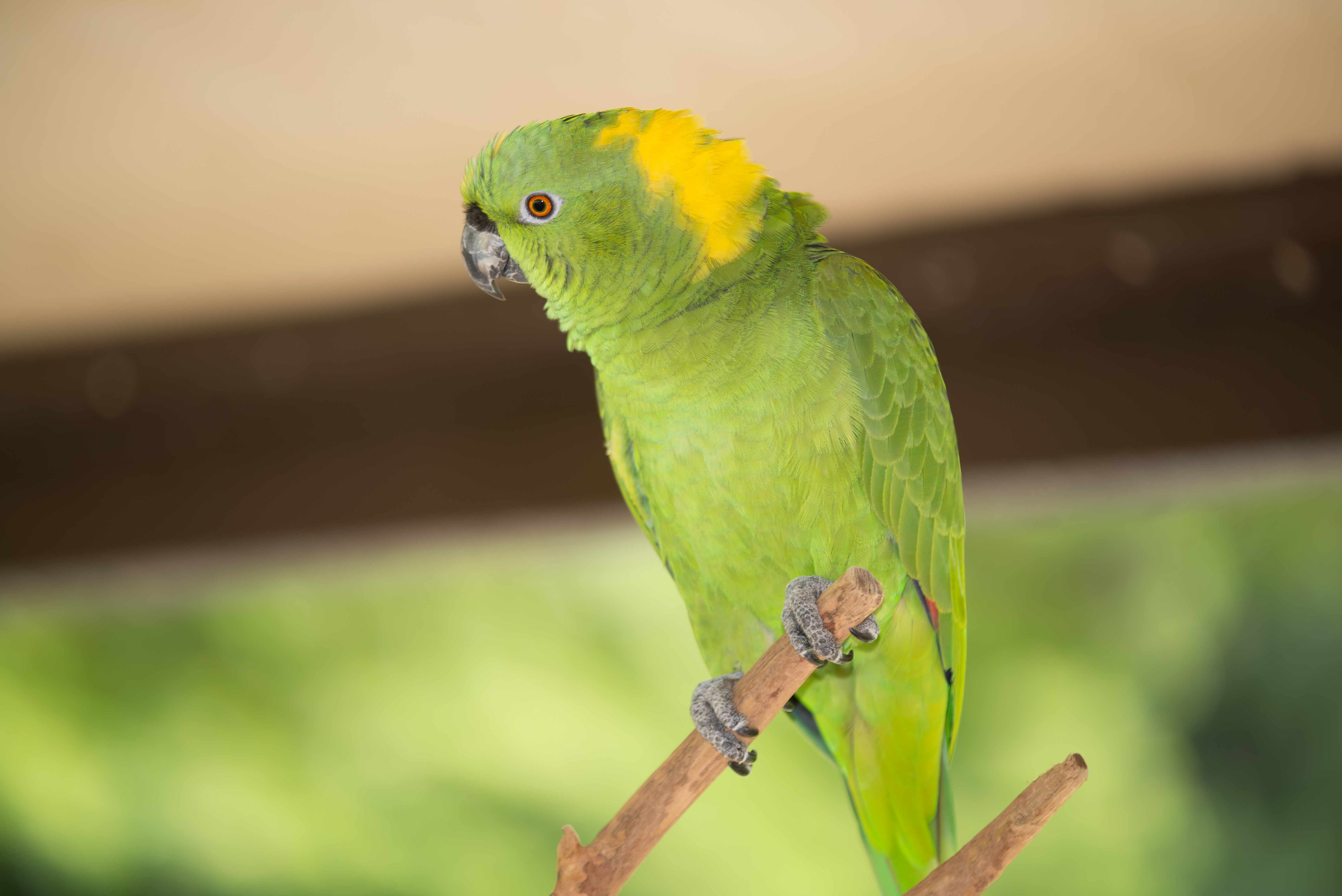
Widely considered the finest talker among the Amazons — highly intelligent, strongly opinionated, and capable of extraordinary vocal mimicry. Males can become territorial and aggressive during breeding season. A magnificent bird for an experienced keeper. Wild populations are now Critically Endangered.
Double Yellow-Headed Amazon
Amazona oratrix
One of the most prized Amazon companions, the DYH develops an increasingly yellow head as it matures — a transformation that takes years. Highly vocal, deeply bonded, and prone to serious aggression in males during hormonal periods. Also Endangered in the wild.
Blue-Fronted Amazon
Amazona aestiva
One of the most common Amazons in captivity worldwide. Recognizable by the blue and yellow markings on its forehead. A good talker and typically somewhat more even-tempered than the Yellow-nape or DYH — though still very much an Amazon in personality. Adaptable and long-lived.
Orange-Winged Amazon
Amazona amazonica
Often confused with the Blue-fronted, the Orange-wing is distinguished by orange rather than red in the wing. Generally considered one of the more gentle Amazon species. Good talker, social, and somewhat less prone to extreme hormonal behavior than the larger species.
Yellow-Crowned Amazon
Amazona ochrocephala
A medium-sized Amazon with a variable yellow crown patch. Playful and social, with solid talking ability. Somewhat less hormonally intense than the Yellow-nape, making it a popular choice for households looking for an Amazon with a slightly more manageable temperament.
White-Fronted Amazon
Amazona albifrons
The smallest commonly kept Amazon, with striking red and blue facial markings and a white forehead patch. One of the few Amazon species in which males and females can be visually distinguished — females lack the red on the wing. Less common in Hawaiʻi but occasionally seen in rescue.
Reading the Room — and the Bird
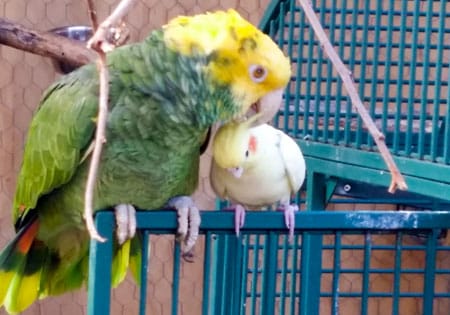
HFFN members and their Amazons — the heart of our monthly meetings
Amazon parrots play hard. They swing upside down from cage bars, shred wooden toys with great enthusiasm, wrestle your hand with their beak, and generally approach life as though it is a contact sport. They are physical, expressive, and thoroughly entertaining — when they want to be.
The flip side of that exuberance is that Amazons shift moods quickly and do not hide it. Among all commonly kept parrots, Amazons are among the most transparent about how they feel — their body language is rich, consistent, and well worth learning before you get anywhere near one. Ignoring the signals is how bites happen.
Male Amazons — particularly Yellow-naped, Double Yellow-headed, and Blue-fronted — become significantly more aggressive during hormonal periods in spring and early summer. Even a well-socialized bird can become unpredictable during this time. This is not a character flaw; it is biology. Experienced Amazon keepers learn to recognize the early signs and adjust their handling accordingly.
An Amazon in “play overload” — especially during beak wrestling — may escalate quickly. Stop the play session as soon as you see overly excited body language and give the bird time to settle before resuming interaction.
Born to Perform
Amazons are among the finest talkers in the parrot world, second only to African Greys in clarity and contextual use of language. They typically begin mimicking sounds well before one year of age and develop their full vocal repertoire over their first several years. Many Amazons acquire vocabularies of hundreds of words and phrases.
An Amazon couldn’t care less whether the song it sings is off-key. It performs as though it wrote the song itself — and that confidence is honestly a large part of the appeal.
Amazons have a particular affinity for music. Many will sing along with songs they have heard repeatedly, matching pitch and melody with surprising accuracy, and some develop strong preferences for particular genres or artists. They often launch into full song performances at predictable times — morning, dusk, and whenever something excites them.
The vocal range extends well beyond talking and singing. They are capable of loud contact calls, repetitive honking sounds when seeking attention, excited chattering during play, and sharp alarm screams. Some make a small shrill sound to express delight while eating a favorite food. Amazons in households with thin walls or close neighbors require realistic expectations: these are not quiet birds, and they never will be.
Consistent routine and sufficient engagement go a long way. An Amazon that is well-exercised, well-fed, and adequately occupied tends to be dramatically less loud than one that is bored or ignored.
Space, Activity, and the Battle Against the Scale
Bright eyes, clean feathering, alert posture — signs of a well-kept Amazon
The single most important care consideration for Amazon parrots is weight management. Amazons love food — all food, especially yours — and they are highly effective at training their owners to share it. Combined with a naturally lower activity level than some other parrots, this makes obesity a genuine and serious health risk. An overweight Amazon faces elevated risk of fatty liver disease, lipomas, heart disease, and shortened lifespan.
The dietary foundation should be a high-quality pelleted diet comprising roughly 60–70% of total intake. The balance should come from a wide variety of fresh vegetables — dark leafy greens, carrots, sweet potato, bell peppers, squash — with limited fruit (high in sugar) and very limited seed and nut offerings. Table food should be a rare treat. Avocado, chocolate, caffeine, onion, garlic, and alcohol are toxic to all parrots and must never be offered under any circumstances.
Amazons love to bathe and should be given regular opportunities — a fine mist spray, a shower with their owner, or a shallow dish of water to splash in. Bathing supports feather condition and skin health, and most Amazons approach it with tremendous enthusiasm. In Hawaiʻi’s climate, bathing is comfortable year-round.
Cage size should be generous — the larger the better. At minimum, an Amazon should be able to fully extend both wings simultaneously without touching the sides. A play gym, climbing ropes, ladders, and a rotating variety of foraging and chew toys are essential. Out-of-cage time should be a daily priority — ideally two or more hours of supervised interaction and activity. An Amazon confined to its cage without sufficient engagement will find its own entertainment, and that rarely ends well for the furniture.
Common Conditions to Watch For
A well-cared-for Amazon parrot on an appropriate diet can live 50 years or more — some documented cases exceed 60 years. The following conditions appear at elevated frequency in this genus:
- Obesity and fatty liver disease
- Lipomas (benign fatty tumors)
- Vitamin A deficiency (seed-heavy diets)
- Psittacosis (Chlamydia psittaci)
- Polyomavirus
- Psittacine Beak and Feather Disease (PBFD)
- Proventricular Dilatation Disease (PDD)
- Respiratory infections
- Feather-destructive behavior
- Aspergillosis (fungal infection)
- Pacheco’s disease (herpesvirus)
- Heavy metal toxicity (zinc, lead)
Annual or biannual avian veterinary examinations, including bloodwork, are strongly recommended. Many Amazon health problems — particularly obesity and vitamin A deficiency — are entirely preventable with an appropriate diet. Avian veterinary resources in Hawaiʻi are limited; establishing a relationship with an avian vet before you need one urgently is essential.
A Genus Under Pressure
The Amazon genus faces significant conservation pressure. Habitat loss through deforestation and agricultural expansion has reduced wild populations across their range, and decades of capture for the pet trade — now largely prohibited under CITES — drove many species to critical levels before protections were established.
Several of the most popular companion Amazon species are now Endangered or Critically Endangered in the wild. The Yellow-naped Amazon (Amazona auropalliata) and the Double Yellow-headed Amazon (Amazona oratrix) are both classified as Endangered by the IUCN. All Amazon parrots in the pet trade in the United States are required by law to be captive-bred; wild-caught importation has been prohibited since the Wild Bird Conservation Act of 1992.
If you are acquiring an Amazon, ensure it comes from a reputable captive breeder with proper documentation. If you are considering adoption, HFFN places birds with vetted homes through a relationship-based process — and many of the Amazons that come through rescue are birds whose history is thoroughly known to us.
Amazons in Rescue — What You Should Know
Amazon parrots are among the most frequently surrendered large parrots in rescue, often by owners who underestimated the commitment involved — particularly around hormonal aggression, noise, and the sheer length of the relationship. A 25-year-old Amazon with a biting history and a colorful vocabulary is not an easy placement, and we will always be honest about what a bird’s history includes.
What rescue Amazons often have in their favor is exactly what makes them challenging: strong personalities, established routines, and decades of learned behavior. With the right experienced home, a previously difficult Amazon can genuinely thrive. Some of our most rewarding placements have been birds that other people gave up on.
HFFN’s adoption process for Amazons — as with all our birds — is relationship-based and unhurried. The bird’s happiness and stability in the new home comes first, always. Come to a meeting, get to know us, and let the process unfold at the bird’s pace.