Hawaiian Feathered Friends Network
Hawaiʻi’s Premier Parrot Rescue · Education · Community Support · Parrot Club Organization
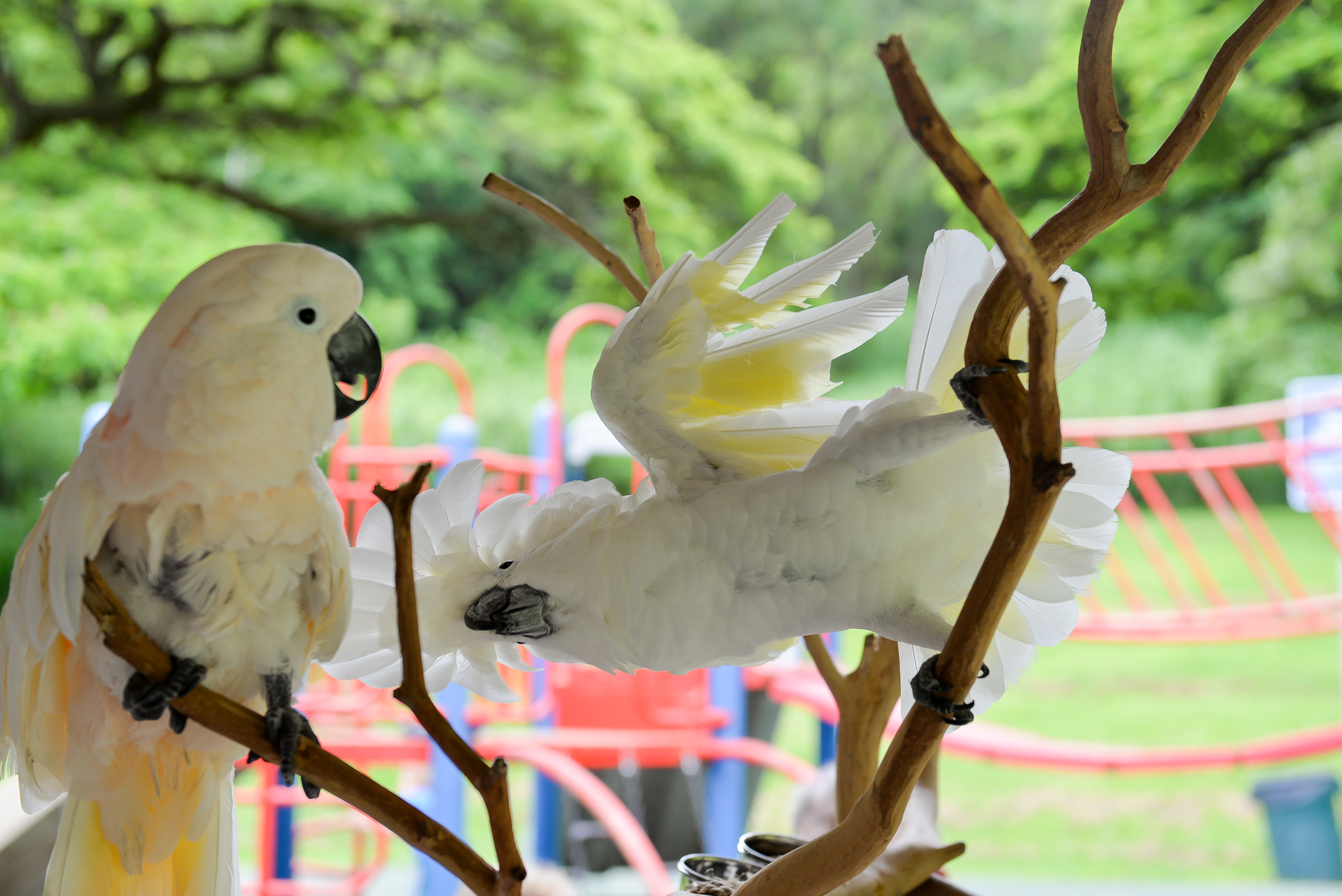
Housing & Enrichment A parrot’s home is its world — make it worthy of the bird who lives there
The right cage, the right placement, and a rich environment of toys, perches, and foraging opportunities are the foundation of a happy, behaviorally healthy parrot. These aren’t luxuries — they’re necessities.
Home Is Everything
In the wild, a parrot’s world is vast — miles of forest canopy, hundreds of species of plants to explore, a flock of companions, and an endless variety of sounds, textures, and challenges. The captive parrot’s world, by contrast, is defined by four walls and whatever we put inside them. That responsibility is enormous, and meeting it well makes the difference between a parrot who merely survives and one who genuinely thrives.
Housing and enrichment aren’t separate concerns — they work together. The cage provides security; enrichment fills it with purpose. Both are essential, and neither can fully compensate for deficiencies in the other.
Choosing the Right Cage
The single most important rule in cage selection: buy the largest cage you can afford and fit in your space. A parrot should be able to fully spread and flap both wings without touching the sides. Bigger is always better — there is no such thing as a cage that is too large.
Bar Spacing
Bar spacing is a safety issue, not just a size issue. Bars too far apart allow a bird to get its head through and become stuck — a potentially fatal situation. Bars too close together prevent climbing and can trap toes. General guidelines:
- Small birds (parrotlets, lovebirds, small conures): ½ inch spacing
- Medium birds (cockatiels, caiques, Amazons, African Greys): ¾ inch spacing
- Large birds (large Amazons, large macaws): 1 to 1½ inch spacing
Minimum Cage Sizes by Bird Size
Parrotlets, Lovebirds, Small Conures
Absolute minimum. Wider is always preferable over taller — parrots fly horizontally, not vertically.
Cockatiels, Caiques, Poicephalus, Amazons, Greys
The bird must be able to fully spread both wings without touching bars. Wider is better than taller.
Macaws, Large Cockatoos, Large Amazons
Macaws in particular need substantial space. A macaw that cannot open its wings fully in its own cage is being poorly housed.
Materials & Construction
Stainless steel is the gold standard — durable, non-toxic, easy to clean, and resistant to the powerful beaks of large parrots. Powder-coated wrought iron is an acceptable and more affordable alternative; inspect regularly for chipping or rust. Avoid cages with zinc or lead components, decorative finishes that can flake, or sharp internal welds. Galvanized wire can cause zinc toxicity and should never be used.
If purchasing a used cage, thoroughly research the construction materials. Older cages may contain lead paint or zinc-coated wire. When in doubt, don’t use it — the risk to your bird’s health is not worth the savings.
Cage Placement
Where you place the cage matters as much as the cage itself. Position one or two sides of the cage against a wall — this gives the bird a sense of security and reduces chronic low-level stress from perceived exposure. Never place a cage in a kitchen (toxic cooking fumes, including Teflon off-gassing, can kill a bird in minutes), in a drafty hallway, or in direct sustained sunlight with no shade option.
Parrots are social animals who want to be part of household activity. Place the cage in a room where the family spends time — a living room or family room — so the bird can observe and participate in daily life without being overwhelmed by constant direct interaction.
Polytetrafluoroethylene (PTFE), the coating used in non-stick cookware, releases fumes when overheated that are odorless to humans but rapidly fatal to birds. A single overheated pan has killed birds several rooms away. Non-stick cookware has no place in a home with parrots.
Perches: Variety Is Foot Health
A parrot stands on its feet every waking hour. Perch variety isn’t an optional enrichment feature — it’s a basic health requirement. Feet that grip the same diameter perch in the same position day after day develop pressure sores and muscle atrophy. Offering different diameters, textures, and shapes keeps feet strong and healthy.
- Natural wood — irregular diameter; best option for foot health and beak conditioning. Manzanita, dragonwood, Java wood. Avoid pressure-treated wood.
- Rope perches — soft surface; good for resting and sleeping. Inspect regularly for frayed threads that can entangle toes. Replace when fraying begins.
- Concrete / pumice perches — positioned near food and water, they help keep nails trim. Use sparingly — one per cage maximum, and never as the primary perch.
- Plastic perches — uniform diameter; not ideal as a primary perch. Use minimally if at all.
- Hanging perches — the movement challenges balance and engages stabilizer muscles. Parrots often love them.
- Fresh-cut branches — a wonderful rotational enrichment item. Safe woods for Hawaiʻi include guava, mango (pesticide-free), monkeypod, and hau. Research carefully before offering any local wood.
A minimum of three to four perches of varying type and diameter should be in every cage. Place them at different heights and avoid positioning any perch directly over food or water bowls.
Enrichment: The Business of Being a Parrot
Enrichment is not entertainment — it is a biological need. Wild parrots spend up to six hours a day foraging, problem-solving, socializing, and exploring. A captive parrot in an empty cage with nothing to do is a parrot in genuine psychological distress, even if it is physically healthy and well-fed.
A bored parrot is not a quiet parrot — it is a suffering parrot expressing that suffering in the only ways available to it.
The Toy Rotation Principle
A toy that has been in the cage for three weeks is no longer enriching — it is furniture. Rotate toys weekly, resting some and reintroducing others. A toy that has been “away” for a month will be greeted with genuine excitement when it returns. You don’t need to spend a fortune; some of the most enriching items cost nothing — a folded paper cup, a piece of palm frond, a fresh mango pit.
Out-of-Cage Time Is Not Optional
Even the most spacious, enriched cage is not a substitute for out-of-cage time. Parrots need daily opportunities to fly or move through a larger space, interact directly with their people, and experience a change of environment. A minimum of three to four hours of supervised out-of-cage time daily is a reasonable baseline for most species, though more is better.
Out-of-cage time should be structured around safety. Before allowing your bird to roam, check for open windows and doors, ceiling fans in motion, other pets, toxic houseplants, and standing water. In Hawaiʻi, open lanai doors and windows with outdoor access require particular vigilance — a parrot that escapes outdoors is in serious danger.
A dedicated play stand or tabletop gym outside the cage gives your bird a safe home base during out-of-cage time. HFFN members build beautiful handcrafted stands from Hawaiian hardwoods — a wonderful enrichment option that also supports local artisans. See our Tree Stands & Perches care page for more.
Sleep: The Underestimated Need
Parrots require 10 to 12 hours of uninterrupted darkness and quiet for proper sleep each night. Chronic sleep deprivation leads to irritability, increased aggression, feather-destructive behavior, and a compromised immune system. It is one of the most common and most overlooked welfare issues in captive parrots.
If the cage is in a busy living room where lights and noise continue late into the evening, a separate sleep cage in a quiet room — or a heavy cage cover paired with a strict household quiet rule after a set time — is essential. Consistency matters as much as duration; parrots thrive on routine, and a predictable sleep schedule is foundational to behavioral stability.
In Hawaiʻi, where evenings are often spent on the lanai with lights and activity, this is an easy need to inadvertently neglect. Build the bedtime routine before you need it, not after behavioral problems have already emerged.
Housing in the Islands
Living in Hawaiʻi presents both advantages and unique challenges for parrot housing. Our year-round warm climate means birds can enjoy outdoor time more easily than on the mainland — but it also introduces specific risks that require attention.
- Humidity and mold: Hawaiʻi’s humidity accelerates mold growth on wooden perches, food residue, and cage materials. Clean cages and perches more frequently than mainland recommendations suggest — weekly scrubbing at minimum.
- Heat and ventilation: While our temperatures are moderate, a cage in direct afternoon sun can overheat quickly. Ensure shade and airflow year-round.
- Escape risk: Open windows, jalousie vents, and lanai doors are a constant escape risk. Screen all openings in rooms where birds have out-of-cage time. A bird loose on Oʻahu faces predators, vehicles, and disorientation.
- Local plants: Many plants common in Hawaiʻi gardens — including some common landscaping plants — are toxic to parrots. Research any plant before allowing your bird access to branches or foliage.
- Mosquitoes and avian disease: Hawaiʻi has significant populations of mosquitoes that carry avian diseases. Birds kept in outdoor aviaries or given outdoor time should be protected from mosquito exposure.