Hawaiian Feathered Friends Network
Hawaiʻi’s Premier Parrot Rescue · Education · Community Support · Parrot Club Organization
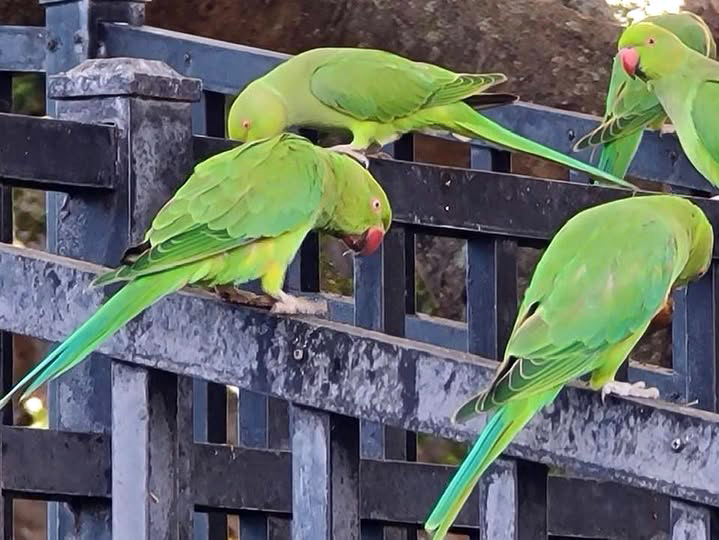
Wild Parrots of Hawaiʻi A Comprehensive Island-by-Island Guide
Every colorful flock wheeling above our neighborhoods traces its origins to the pet trade. Over decades they formed stable populations — and became a permanent part of Hawaiʻi’s avian landscape.
Hawaiʻi Has No Native Parrots
Every colorful, squawking flock that wheels above our neighborhoods, parks, and coastlines traces its origins to the pet trade — birds that escaped their cages, were deliberately released, or flew free during hurricanes. Over decades, many of these birds found our tropical climate and abundant food supply much to their liking, formed stable flocks, began breeding, and are now a permanent part of Hawaiʻi’s avian landscape.
This guide draws on the authoritative reference for Hawaiian birds — The Birds of the Hawaiian Islands: Occurrence, History, Distribution, and Status by Robert L. Pyle and Peter Pyle (Version 2, 2017), published by the Bernice P. Bishop Museum in Honolulu — alongside the Hawaii Invasive Species Council (DLNR-HISC), recent state legislative records, and field reports from birding organizations across the islands.
The Bishop Museum & Hawaii Biological Survey
The Bernice Pauahi Bishop Museum is Hawaiʻi’s State Museum of Natural and Cultural History. Its Hawaii Biological Survey (HBS), created by the State Legislature in 1992, provides an ongoing inventory of all native and non-native fauna and flora in the Hawaiian archipelago, holding over 4 million biological specimens.
The defining bird reference is the Pyle & Pyle (2017) monograph, which documents 338 species with established breeding populations and an additional 160 species reported in the wild without established populations. It is the official scientific baseline for all parrot population data in this guide.
Island-by-Island Quick Reference
| Island | Established Species | Status | Key Notes |
|---|---|---|---|
| Kauaʻi | Rose-Ringed Parakeet | ~20,000 birds | Oldest & largest population in state; severe agricultural impact; eradication not feasible |
| Oʻahu | Rose-Ringed Parakeet, Red-Crowned Parrot, Red-Masked Parakeet, Mitred Parakeet + others | All established; thousands of birds | Highest species diversity; spectacular dusk roosts; Lyon Arboretum cockatoos |
| Maui | Mitred Parakeet | Established; persists despite eradication attempt | Traces to 1 pair released at Huelo 1986–87; Rosy-Faced Lovebird also present |
| Hawaiʻi Island | Red-Masked Parakeet | 50–80+ birds; Kona population | Unique high-elevation roosting on Hualālai; Rosy-Faced Lovebird also present |
| Molokaʻi / Lānaʻi | None established | Occasional escapees only | No breeding populations confirmed |
| Niʻihau | None confirmed | — | Restricted access; no introduced parrot records |
Hawaiʻi’s Parrot Capital
Oʻahu hosts the greatest diversity of introduced parrot species of any island in the state. The island’s abundance of tall palms, flowering trees, banyan groves, and urban food sources has created ideal habitat for multiple species to thrive side by side. Honolulu and its surrounding neighborhoods — from Kapiolani Park to Pearl City — are the best places in all of Hawaiʻi to encounter wild parrots.
Escaped rose-ringed parakeets have been noted in Honolulu since the 1930s (Caum 1933). Counts grew steadily: 75 roosting at Central Union Church in downtown Honolulu in 2000, 240 after the 2006 breeding season, up to 500 in March 2009, and 870 counted on 15 May 2011. Nesting documented in tree cavities at Oʻahu Cemetery and lower Mānoa Valley. The Oʻahu population is estimated at up to 10,000 birds.
At dusk, thousands gather in spectacular roost flights at locations like Beretania & Punahou streets, Central Oʻahu, and Pearl City.
Three free-flying birds were first sighted in about 1969 at Kapiolani Park near the Honolulu Zoo. Numbers grew to 14 by December 1972, with a flock tending a recently fledged chick confirmed in the early 1970s.
When Hurricane Iwa struck 23–24 November 1982, 3–4 pairs escaped from an Aiea aviary and settled in a valley above Pearl City, beginning to nest. The flock grew from 26–40 birds (1987–1993) to over 200 in December 2008, with consistent counts of 130–150 birds through 2016.
Ironically Endangered in its native range of eastern Mexico, making the Oʻahu population of genuine conservation significance.
The first Oʻahu records were of one that escaped from a theme park in upper Mānoa Valley in 1987. By December 1994, 18 birds were documented at Kapiolani Park. A flock roosted at Black Point (1 km east of Diamond Head), departing daily at sunrise over Wailupe, Kahala, and upper ʻĀina Haina Valley to forage. Maximum counts grew: 21 birds (2001), 62 (2004), 53–55 (2005–2016).
During 2004–2006, a female red-masked parakeet nested with a male blue-crowned parakeet, producing 7 wild hybrid offspring — a remarkable documented case of interspecies hybridization.
Native to Argentina, Bolivia, and Peru. Mitred parakeets are characterized by green bodies with variable red facial markings — each bird shows slightly different amounts of red, making individuals recognizable. On Oʻahu they frequently form mixed flocks with red-masked parakeets, increasing flock size and improving predator detection.
Additional Species on Oʻahu
- Blue-Crowned Parakeet (Thectocercus acuticaudatus) — Accompanied the Red-crowned Parrot flock at Kapiolani Park from 1986 and at Pearl City from May 1987. Hybridized with Red-masked Parakeet 2004–2006.
- Crimson-Fronted Parakeet (Psittacara finschi) — Small stable populations in suburban areas and coastal parks. Often joins mixed flocks.
- Yellow-Chevroned Parakeet (Brotogeris chiriri) — Occasional sightings in urban areas; not fully established.
- Macaw escapees — Blue-and-yellow Macaw at Kāneʻohe (2005); Scarlet Macaw at Kailua Beach Park (2012); unidentified macaws in upper Mānoa Valley (1971–72). None established.
Ground Zero for the Rose-Ringed Parakeet Crisis
Kauaʻi has the longest documented parrot history of any island, and today faces the most urgent management challenge. Rose-ringed parakeets were reportedly released by workers at a bed-and-breakfast inn near Lawai during the 1960s.
By November 1982, late afternoon counts at Kukuiolono Park in Kalaheo reached 30–40 birds, with the total estimated at 50 or more. Farmers in Hanapepe Valley obtained state permits to destroy them. By April 1994 a flock of 150–200 birds was reported. By March 1997, parakeets were established from Hanapepe to Māhaʻulepu east of Koloa.
By the mid-2010s, roost counts exceeded 1,000 birds at Prince Kuhio Park near Poʻipū. The 2023 Hawaiʻi Legislature estimated the population at up to 20,000 birds. The Hawaii Invasive Species Council has stated that eradication is no longer feasible — management is the only realistic goal.
The agricultural damage on Kauaʻi is severe. Crop losses affect lychee, mango, papaya, and passion fruit. The birds also strip bark from trees causing tree death, spread invasive yellow guava seeds, and displace native wildlife from tree cavities.
Unique High-Elevation Populations
Hawaiʻi Island hosts a smaller but ecologically distinctive parrot community. The island’s volcanic landscape has produced an unusual behavioral pattern: parrots that forage along warm coastal lowlands by day, then roost and breed at high elevation in volcanic craters.
A flock of 30–40 Psittacara parakeets was observed around Kailua-Kona beginning in 1988. In December 1999 a small flock in downtown Kailua-Kona was positively identified as red-masked parakeets. High counts during the 2010s reached 50–80 birds, with 80 counted on the slopes above Honokāhau on 25 October 2015.
This population primarily forages along the Kona coast and the Kālōka Mauka subdivision above Kona, ranging from downtown Kona south to Hoʻokena Beach and north to Anaehoʻomalu Beach. Added to the Primary Checklist in the 2017 Pyle & Pyle monograph.
One of the smallest parrots found in Hawaiʻi. Vivid green body, peach-to-red face, and cobalt blue tail feathers. Highly social and monogamous, forming tight pair bonds year-round. Small flocks have adapted to local conditions on the Big Island and Maui. While endearing, they can cause crop damage and consume seeds of native plants.
Smaller Populations, Persistent Presence
Maui’s parrot history illustrates a fundamental truth about introduced parrots: even a single released pair can establish a permanent population. Despite active eradication efforts by the Division of Forestry and Wildlife, the birds persist.
Maui’s mitred parakeet population traces to a single pair of pet conures deliberately released in Huelo around 1986–1987. A 1996 USGS/Bishop Museum field study confirmed the population in the Haʻikū District at 28–30 birds. By 2006 a second group expanded to 40 birds at Waipaʻā Bay, and the two groups joined at dawn to forage in fruit and nut trees primarily between Huelo and Hoʻolawā Valley.
Despite eradication attempts, the population persisted and was officially added to the Hawaii Checklist by Pyle (2002). Note: In Hawaiʻi the mitred parakeet nests on sea cliffs — unlike Florida, where it nests almost exclusively on human structures.
Rosy-faced lovebirds are also observed on Maui, particularly near Keālia Pond National Wildlife Refuge. A small number of rose-ringed parakeets have been documented (Makawao 1988; along the Hāna Hwy 1990; Napili Bay 2014), but have not established a breeding population.
The Cockatoos of Mānoa Valley
One of Oʻahu’s most beloved and best-kept birdwatching secrets is a mixed flock of wild cockatoos that has inhabited the upper end of Mānoa Valley — centered on the Harold L. Lyon Arboretum — for over 50 years. These are not parakeets. These are large, crested, dramatically loud cockatoos, and hearing their screeches echo off the valley walls is an unforgettable experience.
The Pyle & Pyle (2017) Non-Established Species List documents six cockatoo species at Lyon Arboretum. None have yet met the 15-year established breeding threshold for the Primary Checklist, though local breeding has been confirmed and the flock has persisted for over five decades.
The dominant species in the Mānoa flock since the 2000s. Large and white with a distinctive salmon-pink crest raised when alarmed or excited. First documented at Lyon Arboretum in 1972–1983 (1–3 birds), then 2–8 birds from 1991 through 2016, reaching an apparent maximum of 8 birds.
Ironically Endangered in its native Seram (southern Moluccas, Indonesia), making the Mānoa flock of genuine global conservation interest. Has reportedly hybridized with the sulphur-crested cockatoo in Mānoa.
The most numerous cockatoo species in the Mānoa flock historically, with up to 30 birds reported at Lyon Arboretum from 1991 to 2012. A smaller, all-white cockatoo with a pale salmon-pink tinge at the base of the bill. Native to the Tanimbar Islands of Indonesia.
First escape documented from Paradise Park in spring 1987. Also reported across Oʻahu (Haleiwa, Makiki, Kāhuku, Punaluʻu, Kāneʻohe) and up to 7 birds above Kona on the Big Island in 2015–2016.
The familiar large white cockatoo with a bright yellow crest. At Lyon Arboretum, 4–6 (possibly up to 11) were reported from 1992 to 2005. One to four birds appeared on the Honolulu Christmas Count from 2002 to 2006. Has reportedly hybridized with the salmon-crested cockatoo, complicating identification. Individual escapees also documented at Diamond Head (1980), Kāneʻohe (1987), Kāhuku (1996), and along the Aiea Trail (2012).
Two were reported at Lyon Arboretum from June 1982 through December 1983. Smaller than the sulphur-crested, with a yellow crest. Critically Endangered in its native range across Wallacea, Indonesia — the Mānoa sightings represent one of the few documented feral records of this species anywhere in the world.
The most dramatic of all — one individual was documented at Lyon Arboretum with the other cockatoos for some time in at least 1983. The palm cockatoo is extraordinary: all-black or dark grey with bare red facial patches that flush deeper red with excitement, and an enormous black crest. Native to New Guinea and Cape York Peninsula, Australia. No further records after 1983.
Visiting Lyon Arboretum
- Listen first — cockatoo screams carry far through the valley. Look up into tall eucalyptus and large tropical trees along the trails.
- The salmon-crested cockatoo (most common today) is large, white, and shows a pinkish-salmon blush to its crest and underparts.
- Hybridization between species has occurred — some birds may show intermediate features. Even experts find identification challenging.
- Best times: Early morning and late afternoon when the flock is most active. They are not always present — some days you will only hear distant screeching.
- Log your sightings on eBird with photos if possible to help track which species remain in the flock today.
Other Islands
Molokaʻi and Lānaʻi: No breeding parrot populations confirmed. Occasional escapees from the pet trade may appear, but neither island has developed the food supply or habitat density needed for self-sustaining flocks.
Niʻihau: The privately-owned “Forbidden Island” has no confirmed parrot records. Its restricted human access has inadvertently helped protect it from many invasive species.
Kahoʻolawe: Uninhabited and under active ecological restoration. No confirmed parrot populations.
Notable Historical Macaw Records (Bishop Museum Non-Established List)
- Blue-and-Yellow Macaw (Ara ararauna) — South Point Hawaiʻi Island (2002), Kāneʻohe Oʻahu (2005), above Lānikai (2015).
- Scarlet Macaw (Ara macao) — Two escapees in Honolulu (Caum 1933). Remarkably, two birds owned by Queen Liliʻuokalani were shipped to Parker Ranch, Hawaiʻi Island after her death in 1917 and allowed free range until 1948. Two also reported at Kailua Beach Park, Oʻahu on 17 October 2012.
- Military Macaw (Ara militaris) — One reported during Pūʻu o Kakaʻe Christmas Count week, Maui, 1991.
Conservation & Ecological Impact
As bird lovers, we hold a nuanced position. Wild parrots are beautiful, intelligent, and charismatic — but every species present in Hawaiʻi is here because of human action, and their presence comes at a real cost to our islands’ native ecosystems and farming communities.
Key Ecological Concerns
- Competition for nesting cavities — Parrots aggressively displace native Hawaiian birds from tree cavities needed for nesting and roosting.
- Agricultural damage — Crop losses affect lychee, mango, papaya, passion fruit, macadamia nuts, and Kona coffee.
- Disease transmission — Parrots can carry and spread psittacosis and avian pox through wild bird populations.
- Invasive plant spread — Parrots inadvertently spread invasive plants including yellow guava.
- Tree death — Rose-ringed parakeets strip bark from trees, causing progressive tree death in affected areas.
Legal Framework
All wild birds in Hawaiʻi — including introduced species — are protected under Hawaii Revised Statutes (HRS183D and HAR124). A nuisance wildlife control permit from DLNR is required before any population management actions can be taken. It is illegal to release introduced birds into the wild or to transport established invasive species between islands.
How You Can Help
- Log parrot and cockatoo sightings on eBird to contribute to statewide population monitoring.
- Never release pet birds into the wild — Maui’s mitred parakeet colony traces to a single released pair.
- Advocate for humane, science-based population management balancing ecological impact with animal welfare.
Primary Sources
- Pyle, R.L., and P. Pyle. 2017. The Birds of the Hawaiian Islands: Occurrence, History, Distribution, and Status. B.P. Bishop Museum, Honolulu. Version 2 (1 January 2017). hbs.bishopmuseum.org/birds/rlp-monograph
- Bishop Museum Hawaii Biological Survey Publications. hbs.bishopmuseum.org/hbspubs.html
- Hawaii Invasive Species Council (DLNR-HISC). Rose-Ringed Parakeet Species Profile. dlnr.hawaii.gov/hisc
- Hawaii House Resolution HR47 (2023). Urging development of a comprehensive strategy for managing the rose-ringed parakeet population.
- Kauaʻi Rose-Ringed Parakeet Working Group / Kauaʻi Office of Economic Development. Citizen Science Mapping Initiative, 2024.
- VanderWerf, E.A., et al. 2017. Hawaiian Islands Bird Checklist. ʻElepaio 77:6. Hawaii Audubon Society.
- USGS/BRD/PIERC Haleakalā Field Station. 1996. Free-ranging parrot population of Haiku District, Maui.
- Birdfinding.info — Lyon Arboretum, Oʻahu. birdfinding.info