Hawaiian Feathered Friends Network
Hawaiʻi’s Premier Parrot Rescue · Education · Community Support · Parrot Club Organization
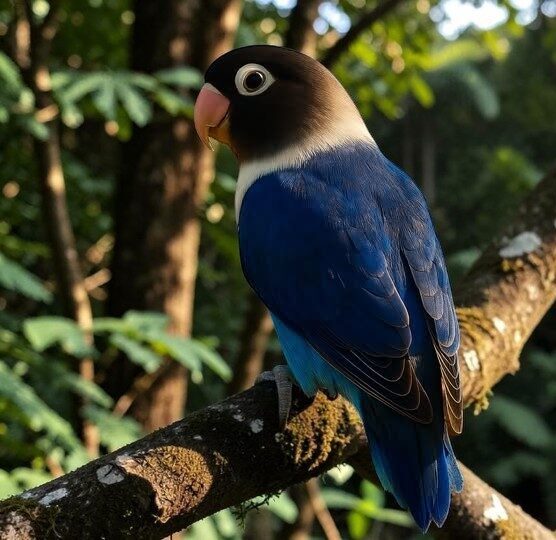
LovebirdSmall Bird, Giant Heart
Don’t let the small size fool you. Lovebirds are bold, feisty, deeply affectionate, and spectacularly colorful — with a personality that routinely surprises people who expected something quiet and easy. They are parrots. Fully, completely, enthusiastically parrots.
Africa’s Little Giants
Lovebirds — genus Agapornis — are a group of nine small parrot species native to sub-Saharan Africa and Madagascar. They range from about 13 to 17 cm in length and are among the most compact true parrots kept in aviculture. The name “lovebird” comes from the strong, demonstrative pair bonds these birds form — mated pairs spend hours in close physical contact, preening each other, roosting pressed together, and defending their shared space with impressive territorial zeal.
What surprises many first-time lovebird owners is how fully parrot these little birds are. They have the intelligence, the emotional complexity, the territoriality, the need for enrichment and interaction, and yes — the beak — of a much larger bird. A lovebird bite from a motivated individual is nothing to dismiss. Their small size is not a measure of their personality, their needs, or their capacity for a deep bond with their keeper.
In Hawaiʻi, lovebirds are well represented in the HFFN community and among the broader bird-keeping population. The Peach-faced Lovebird is by far the most commonly kept — and the species with the most extraordinary range of color mutations in aviculture. But several other species are also kept and appreciated by dedicated members of our community.
A lovebird is a parrot that got shrunk in the wash. Everything is still there — the intelligence, the territorial instinct, the deep bond, the very sharp beak — just in a more compact and arguably more dangerous package.
Peach-faced (Rosy-faced) Lovebird
Peach-faced Lovebird
Peach-faced Lovebird
Wild-type green
Add photo here
Peach-faced Lovebird
Pair together
Add photo here
Peach-faced Lovebird
Member bird on Oʻahu
Add photo here
The Peach-faced Lovebird is the most widely kept lovebird species in the world and the undisputed king of lovebird aviculture. In its wild-type form it is vivid green with a salmon-peach face and forehead, a bright blue rump (visible in flight), and a short red-tipped tail. It is native to the arid and semi-arid regions of southwestern Africa — Namibia, Angola, and the northwestern Cape — where it inhabits scrub, dry woodland, and rocky terrain near water sources.
The Peach-faced Lovebird has also established feral populations in several locations outside its native range — most notably in the Phoenix, Arizona metropolitan area, where thousands of birds thrive in the urban environment. In Hawaiʻi, small feral populations have been documented on Maui and Hawaiʻi Island. See our Wild Parrots of Hawaiʻi page for details.
Personality: Peach-faced Lovebirds are bold, feisty, and deeply affectionate — with their person and their mate. They are one of the more independent lovebird species and can do well singly with a committed human companion, or in pairs. Single birds that receive consistent daily interaction typically develop the strongest bonds with their keeper. Pairs are deeply devoted to each other but may become less interested in human interaction — a trade-off worth considering before deciding whether to keep one or two.
They are active, curious, and enthusiastic chewers. Enrichment must be provided in generous rotation. They also have a habit of tucking nesting material into their rump feathers — an endearing behavior unique to this species in the Agapornis genus.
🎨 Color Mutations — The Most Extensive Mutation Catalog in Lovebird Aviculture
The Peach-faced Lovebird has more recognized color mutations than any other lovebird species — and more than most parrots of any size. The base mutations interact with each other to produce an extraordinary range of colors and patterns. The following lists the major mutations; combinations of these produce hundreds of distinct visual varieties.
- Lutino — Yellow body, white face, red eyes; one of the earliest and most popular mutations
- Dutch Blue — Sky blue body replacing green, white face replacing peach
- American Yellow (Golden Cherry) — Yellow-green body, reduced face color; recessive
- Cinnamon (Fallow) — Warm brown replacing dark pigment throughout the plumage
- Cremino — Lutino + Dutch Blue combination; cream-white body, pink-red eyes
- Violet — Adds purple-violet suffusion to blue-based birds
- Turquoise (Seafoam) — Blue-green intermediate between green and blue series
- White-faced Blue — Blue body with completely white face; no peach pigment
- Pied — Irregular patches of reduced or absent pigmentation; highly variable
- Opaline — Alters the distribution of color between body and flight feathers
- Pallid — Reduces dark pigment throughout; paler overall appearance
- Dark Factor — Single dark factor produces medium shade; double produces dark olive or dark blue
- Aqua — Green + Dutch Blue combination; distinctive aqua-green color
- Jade — Dark factor green; deeper, richer green than wild-type
- Cobalt — Dark factor blue; deeper blue than Dutch Blue
- Mauve — Double dark factor blue; deep blue-grey
Lutino
mutation
Dutch Blue
mutation
Cremino
mutation
American
Yellow
Pied
mutation
Cinnamon
mutation
Violet
mutation
White-faced
Blue
Turquoise
mutation
Multi-gene
combination
Masked Lovebird
Masked (Yellow-collared) Lovebird
Masked Lovebird
Wild-type — black mask, yellow collar
Add photo here
Masked Lovebird
Member bird on Oʻahu
Add photo here
The Masked Lovebird is the second most commonly kept lovebird species and one of the most immediately recognizable — a vivid green bird with a bold black head mask, bright yellow collar, red bill, and distinctive white eye ring. It is native to the inland plateau of northern Tanzania, where it inhabits grassland, dry woodland, and cultivated areas. Feral populations exist in several locations including Hawaii and Tanzania’s coastal areas.
The Masked Lovebird is one of the “eye-ring” group of lovebirds — species distinguished by a prominent white eye ring around the eye — which also includes the Fischer’s, Nyasa, and Black-cheeked Lovebirds. Eye-ring species are generally considered slightly calmer and more broadly sociable than the Peach-faced, and they do not carry nesting material in their rump feathers.
Personality: Masked Lovebirds are energetic, playful, and curious — with the characteristic lovebird combination of deep affection and territorial boldness. They are among the better talkers in the lovebird family, though their vocabulary is typically limited compared to larger parrot species. Single birds that receive consistent daily interaction bond strongly with their keeper. Well-socialized Masked Lovebirds tend to be slightly more accepting of multiple people than Peach-faced.
🎨 Color Mutations
- Blue — The most popular Masked mutation; blue body replacing green, white collar replacing yellow, black mask retained. Stunning contrast.
- Cobalt — Dark factor blue; deeper, richer blue than standard blue mutation
- Mauve — Double dark factor blue; deep blue-grey body
- Violet — Adds purple-violet suffusion to blue-based birds
- White — Blue mutation combined with dilute factor; pale blue-white appearance
- Yellow — Dilute green mutation; pale yellow-green body
- Albino — Blue + dilute combination; white body, red eyes
Masked Lovebird
Blue mutation
Add photo here
Masked Lovebird
Cobalt mutation
Add photo here
Masked Lovebird
Violet mutation
Add photo here
Fischer’s Lovebird
Fischer’s Lovebird
Fischer’s Lovebird
Wild-type — orange head, green body
Add photo here
Fischer’s Lovebird
Member bird on Oʻahu
Add photo here
Fischer’s Lovebird is one of the most colorful members of the eye-ring group — a vivid green bird with a rich orange-red head that grades to yellow on the nape, a bright red bill, blue rump, and white eye ring. It is native to a relatively small range in northern Tanzania, south and southeast of Lake Victoria, where it inhabits open woodland, grassland, and areas near water.
Fischer’s Lovebirds are closely related to Masked Lovebirds and will hybridize with them — producing fertile offspring — which has resulted in a significant number of hybrid individuals in aviculture. Pure Fischer’s and pure Masked are preferred by serious breeders who maintain accurate records and lineages. The hybrid population makes accurate identification more challenging when acquiring birds from unknown sources.
Personality: Fischer’s Lovebirds share the eye-ring group’s generally sociable character — energetic, playful, curious, and affectionate with their bonded person. They tend to be slightly less territorially aggressive than Peach-faced and somewhat more accepting of other birds in a communal setting. Well-socialized Fischer’s are delightful companions and are well represented in the HFFN community.
🎨 Color Mutations
- Blue — Blue body replacing green; white head replacing orange; retains white eye ring
- Lutino — Yellow body, orange-red head retained; red eyes
- Albino — Blue + dilute; white body, red eyes
- Cinnamon — Warm brown replacing dark pigment; yellow-green overall appearance
- Yellow (Dilute) — Pale yellow-green body; reduced pigmentation throughout
- White — Blue mutation + dilute; pale white-blue appearance
Fischer’s Lovebird
Wild-type
Add photo here
Fischer’s Lovebird
Blue mutation
Add photo here
Fischer’s Lovebird
Lutino mutation
Add photo here
Black-cheeked Lovebird
Black-cheeked Lovebird
Black-cheeked Lovebird
Wild-type — dark cheeks, orange breast
Add photo here
Black-cheeked Lovebird
Pair together
Add photo here
The Black-cheeked Lovebird is one of the rarest lovebird species in both the wild and in aviculture. A member of the eye-ring group, it has a distinctive dark brown-black cheek and throat, an orange-red breast, green body, and the characteristic white eye ring. It is found only in a small area of western Zambia around the Kafue River basin, where it is Vulnerable due to habitat loss and dependence on specific water sources.
In aviculture, the Black-cheeked Lovebird is a specialist’s bird — rarely seen, carefully bred by dedicated keepers maintaining studbook records, and not typically available through general pet channels. HFFN members who keep this species are contributing meaningfully to the conservation of a genuinely threatened bird. If you encounter a Black-cheeked Lovebird in Hawaiʻi, it is worth noting.
Mutations: Few established mutations exist for this species in aviculture. A blue mutation has been documented but is extremely rare. Most captive Black-cheeked Lovebirds are wild-type.
Black-cheeked Lovebird
Add photo here
Black-cheeked Lovebird
Add photo here
Nyasa (Lilian’s) Lovebird
Nyasa (Lilian’s) Lovebird
Nyasa Lovebird
Wild-type — orange head, green body
Add photo here
Nyasa Lovebird
Add photo here
The Nyasa Lovebird — also known as Lilian’s Lovebird — is the smallest of the eye-ring lovebird species and closely resembles Fischer’s Lovebird. It has an orange-red head, green body, blue rump, and white eye ring, but is slightly smaller overall and has a shorter bill. It is native to the woodland and riparian areas of east-central Africa — Malawi, Mozambique, Zambia, and Zimbabwe — where it is Near Threatened due to habitat degradation.
Nyasa Lovebirds are uncommon in aviculture and rarely seen in Hawaiʻi. Like the Black-cheeked, birds kept in captivity are typically maintained by specialist breeders with careful attention to genetic diversity. They hybridize readily with Fischer’s Lovebirds, making pure specimens increasingly important to identify and protect through careful breeding records.
Mutations: Rare in aviculture. A lutino mutation exists but is uncommon. Wild-type is the overwhelming norm in captive populations.
Abyssinian (Black-winged) Lovebird
Abyssinian (Black-winged) Lovebird
Abyssinian Lovebird — Male
Red forehead and eye ring
Add photo here
Abyssinian Lovebird — Female
All green, no red
Add photo here
The Abyssinian Lovebird is one of the sexually dimorphic lovebird species — meaning males and females look different from each other. Males are predominantly green with a bright red forehead, red eye ring, and red lores (area between eye and bill). Females are entirely green with no red. Both sexes have distinctive black undersides to the primary wing feathers — the “black-winged” of the common name — which are visible in flight.
The Abyssinian is the largest lovebird species and a highland specialist — native to the montane forest of Ethiopia and Eritrea at elevations of 1,500–3,300 meters. Their highland origin makes them somewhat more tolerant of cool temperatures than the lowland lovebird species. They are rare in aviculture worldwide and essentially specialist birds in Hawaiʻi.
Mutations: Very few established mutations. A cinnamon mutation has been documented. Wild-type is the norm in captive populations. Sexual dimorphism makes visual sexing straightforward — a significant advantage in a family where most species require DNA testing to determine sex.
Red-headed Lovebird
Red-headed Lovebird
Red-headed Lovebird — Male
Vivid red head
Add photo here
Red-headed Lovebird — Female
Orange-red head (paler than male)
Add photo here
The Red-headed Lovebird is another sexually dimorphic species — males have a vivid red head while females have a paler orange-red head, making visual sexing possible though sometimes subtle. Both sexes are predominantly green with a blue rump and short red-tipped tail. Native to a broad range across equatorial Africa from Guinea east to Uganda and south to Angola.
The Red-headed Lovebird has a reputation as a challenging aviculture bird — it nests in arboreal termite mounds in the wild, a nesting requirement that is difficult to replicate in captivity and has historically made successful captive breeding difficult. It tends to be more nervous and less amenable to taming than the Peach-faced or eye-ring species, and is generally kept in outdoor aviaries rather than as a hands-on companion bird. Rarely seen in Hawaiʻi.
Mutations: Essentially unknown in aviculture. Wild-type only.
Madagascar (Grey-headed) Lovebird
Madagascar (Grey-headed) Lovebird
Madagascar Lovebird — Male
Grey head and breast
Add photo here
Madagascar Lovebird — Female
All green
Add photo here
The Madagascar Lovebird is the only lovebird species found outside continental Africa — endemic to the island of Madagascar, where it inhabits a range of open habitats from coastal areas to inland grassland and cultivated land. It is the smallest lovebird species and sexually dimorphic: males have a distinctive pale grey head and breast that contrasts with their vivid green body; females are entirely green.
Madagascar Lovebirds are considered among the most delicate and challenging lovebird species in aviculture. They are nervous, difficult to tame, and have specific requirements for temperature, humidity, and nutrition that make them unsuitable for most casual bird owners. They are generally kept by specialist aviculturists in outdoor aviaries rather than as companion birds. Extremely rare in Hawaiʻi — any Madagascar Lovebird encountered here is a remarkable bird in the hands of a dedicated specialist.
Mutations: Essentially unknown in aviculture. Wild-type only.
Black-collared (Swindern’s) Lovebird
Black-collared (Swindern’s) Lovebird
Black-collared Lovebird
Reference only — not kept in captivity
Add photo here
Black-collared Lovebird
Wild photo reference
Add photo here
The Black-collared Lovebird is included here purely for the sake of a complete genus overview — it is not a bird that can be kept in captivity in any practical sense. This species has a dietary requirement for native African fig seeds (Ficus species) that cannot be replicated outside its native forest habitat. Every attempt to maintain this species in captivity has failed within days to weeks. It is the only lovebird species that has never been successfully established in aviculture.
The Black-collared is a vivid green bird with a distinctive black collar on the nape, a yellow-orange lower back, and red bill. It is native to the forest belt of equatorial Africa from Liberia east to Uganda. It is listed here because Agapornis includes nine species and a complete reference page should acknowledge all of them — even the ones that will never appear at an HFFN meeting.
Keeping Lovebirds in Hawaiʻi
Lovebirds are hardy, adaptable birds that thrive in Hawaiʻi’s warm climate. The following care guidelines apply broadly to the commonly kept species — Peach-faced, Masked, and Fischer’s. Specialist species (Black-cheeked, Nyasa, Abyssinian, Red-headed, Madagascar) have additional requirements beyond the scope of general guidance.
Housing: A minimum cage of 24 × 18 × 24 inches for a single lovebird; larger for a pair. Bar spacing of ½ inch maximum — lovebirds are small enough to get their heads through larger spacing with disastrous results. They are active birds that appreciate horizontal cage bars for climbing. Natural wood perches of varying diameters are important for foot health.
Diet: A high-quality small parrot pelleted diet comprising 60–70% of intake, supplemented with fresh vegetables, limited fruit, and a small amount of seed. Lovebirds are prone to nutritional deficiencies on seed-only diets. Dark leafy greens, sweet potato, carrot, and bell pepper are excellent additions. In Hawaiʻi, fresh local produce is both excellent and year-round accessible.
One or two? The “do lovebirds need a companion” question is more nuanced than the name suggests. A single lovebird that receives consistent daily handling and interaction from its keeper can bond deeply with that person and thrive. A pair will bond intensely with each other, which often reduces — though does not eliminate — their bond with their keeper. The decision depends on your schedule, your lifestyle, and what kind of relationship you want with the bird. Come talk to HFFN members who have tried both — you will get honest answers.
⚠️ Lovebirds and Other Species
Lovebirds should not be housed with larger parrot species unsupervised. Despite their small size, lovebirds are bold and territorial and will attack much larger birds — sometimes causing serious injuries to the larger bird, and inevitably resulting in serious injury or death to the lovebird. Introductions between lovebirds and other species require careful supervision and should never be left unattended.
Nesting Behavior — Even Without a Mate
Lovebirds have strong nesting instincts that can be triggered in single birds — particularly females — even without a mate. Female lovebirds may seek out enclosed spaces, shred paper obsessively, and become more territorial and hormonal during breeding season. Managing access to enclosed spaces and limiting nesting material helps moderate these behaviors. Consult an avian vet if chronic egg-laying becomes a concern — it is a manageable condition that nonetheless requires attention.
Common Conditions to Watch For
Well-cared-for lovebirds are generally healthy and relatively long-lived for their size — Peach-faced and Masked Lovebirds commonly reach 15–20 years in captivity with proper care. The following conditions appear most frequently:
- Psittacine Beak and Feather Disease (PBFD)
- Psittacosis (Chlamydia psittaci)
- Avian Gastric Yeast (Megabacteria / AGY)
- Polyomavirus
- Feather-destructive behavior
- Egg binding (females)
- Chronic egg-laying (females)
- Aspergillosis (fungal infection)
- Nutritional deficiency (seed-heavy diets)
- Heavy metal toxicity (zinc, lead)
- Intestinal parasites
- Respiratory infections
Avian Gastric Yeast (AGY), also known as Megabacteria, is a condition seen with some frequency in lovebirds — it causes progressive weight loss and digestive dysfunction and is often initially missed because affected birds may maintain normal appetite and behavior until the condition is advanced. Any lovebird showing unexplained weight loss should be evaluated by an avian vet promptly. Annual examinations are strongly recommended.
Lovebirds in Rescue
Lovebirds are among the most commonly surrendered small parrots in Hawaiʻi — usually because an owner did not appreciate the full reality of keeping a parrot before acquiring one, or because a pair produced offspring faster and in greater numbers than the owner anticipated. Lovebirds are enthusiastic breeders that will produce multiple clutches per year if given the opportunity and the nesting materials.
HFFN places lovebirds through our adoption process. Most rescue lovebirds, with patient handling and improved diet, settle into new homes reasonably well. The Peach-faced in particular is typically quite adaptable. If you are interested in adopting a lovebird, come to a meeting — we almost always have lovebird owners present who can share their experience and help you assess whether this species is the right fit for your household.