Hawaiian Feathered Friends Network
Hawaiʻi’s Premier Parrot Rescue · Education · Community Support · Parrot Club Organization
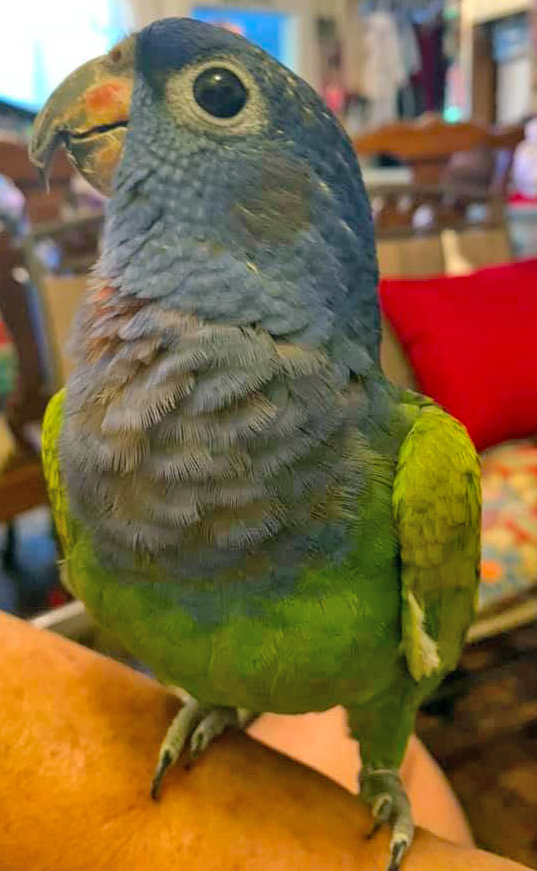
Pionus ParrotAviculture’s Best-Kept Secret
Calm, gentle, loyal, and quietly beautiful — the Pionus is the parrot that experienced bird keepers keep recommending and newcomers keep overlooking. That is their loss, and your opportunity.
The Parrot That Rewards Patience
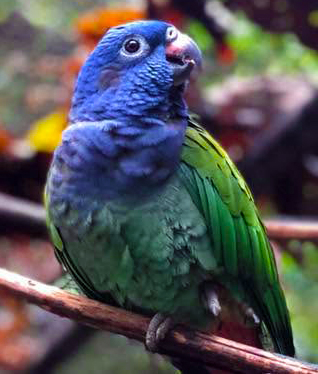
Blue-headed Pionus — Hawaiʻi Parrot Forum member photo
The genus Pionus comprises eight species of medium-sized parrots native to Mexico, Central America, and South America, ranging from the highlands of Mexico south through the Andes to Bolivia and Argentina. They inhabit a wide range of environments — tropical and subtropical forest, forest edges, savanna, and montane woodland — and are generally birds of middle elevations rather than deep lowland rainforest.
In overall appearance, Pionus parrots are stocky, short-tailed, and compact — somewhat similar in build to Amazon parrots, with whom they are closely related. They range in length from about 25 to 30 cm depending on species. All eight species share a distinctive feature: vivid red undertail coverts (the feathers under the base of the tail) that flash brilliantly when the bird takes flight — a field mark that immediately identifies any Pionus in flight regardless of species.
What makes the Pionus genuinely special in aviculture is not any single dramatic feature but rather a combination of qualities that experienced keepers quickly come to treasure: a calm, steady temperament; moderate noise levels that are genuinely compatible with apartment living; a deep capacity for bonding without the extreme emotional demands of cockatoos; good health and hardiness relative to some other species; and a quiet intelligence that reveals itself gradually over years of companionship.
The Pionus is not the parrot that commands attention when you walk into a pet store. It will not scream for you. It will not perform tricks on command the moment you meet it. It will watch you carefully from across the room, assess you with calm dark eyes, and — if you are patient and consistent — eventually decide that you are worth knowing. That process, and the bond that results from it, is something Pionus owners describe with a particular kind of reverence.
Every experienced Pionus owner eventually says the same thing: I had no idea what I was getting into — and I mean that in the best possible way.
Blue-headed & White-capped — Our Community’s Favorites
HFFN and Hawaiʻi Parrot Forum members keep several Pionus species, but the Blue-headed and White-capped are the most commonly seen in our community. Both are represented by beautiful photographs contributed by our members — and both illustrate perfectly why this genus deserves wider appreciation in the islands.
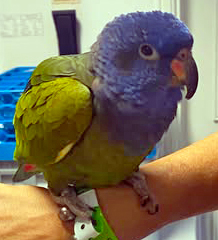 Hawaiʻi Parrot Forum member photo
Blue-headed Pionus
Pionus menstruus
The most widely kept Pionus species in aviculture and the one most commonly seen in Hawaiʻi. The Blue-headed Pionus has a striking cobalt blue head and throat that contrasts dramatically with its rich green body. The undertail coverts are the characteristic vivid red of the genus. Blue-headed Pionus are native to a large range from Costa Rica through Colombia, Venezuela, Ecuador, Peru, Bolivia, and Brazil. They are generally considered one of the more outgoing and talkative Pionus species — a little more animated than the Maximilian’s, a little less reserved than the White-capped. A wonderful first Pionus for anyone new to the genus.
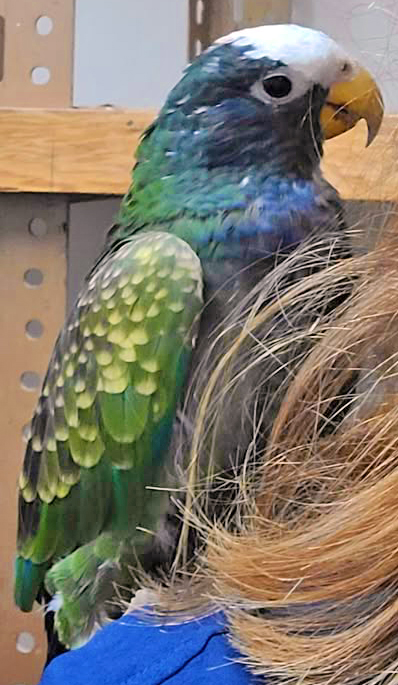 Hawaiʻi Parrot Forum member photo
White-capped Pionus
Pionus senilis
The smallest of the commonly kept Pionus species — about 24–25 cm — and one of the most visually distinctive. The White-capped Pionus has a white forehead and crown patch, a blue-violet body, and green wings. It is native to Mexico and Central America, ranging from eastern Mexico through Honduras, Costa Rica, and western Panama. White-capped Pionus are considered somewhat more independent and less overtly affectionate than the Blue-headed, but deeply loyal to their people. Their smaller size makes them one of the most practical Pionus options for apartment living in Hawaiʻi.
Blue-headed Pionus — the vivid cobalt head is unmistakable · Hawaiʻi Parrot Forum member photo
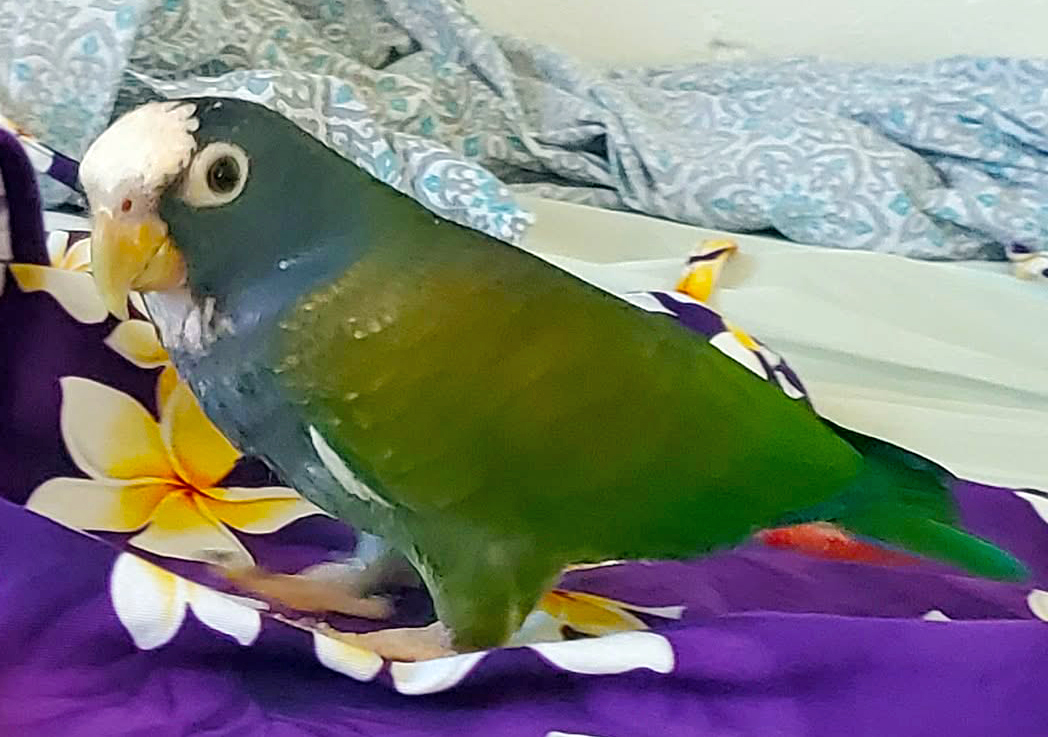
White-capped Pionus — the white crown patch is the key field mark · Hawaiʻi Parrot Forum member photo
All Eight Pionus Species
The eight recognized Pionus species vary in coloration, size, and temperament — but all share the genus’s characteristic calm, gentle nature and the distinctive red undertail coverts. The following covers the full genus, from the commonly kept to the rarely encountered.
Hawaiʻi Parrot Forum member photo
Blue-headed Pionus
Pionus menstruus
Cobalt blue head and throat, rich green body, vivid red undertail. The most common Pionus in aviculture worldwide. Relatively outgoing and talkative for the genus. Native to Costa Rica through much of South America. The recommended starting point for anyone new to Pionus.
Hawaiʻi Parrot Forum member photo
White-capped Pionus
Pionus senilis
White forehead and crown patch, blue-violet body, green wings. Smallest of the commonly kept Pionus. Native to Mexico and Central America. Independent and loyal — somewhat more reserved than the Blue-headed but deeply bonded to its person once trust is established.
Maximilian’s (Scaly-headed) Pionus
Pionus maximiliani
The most subdued in coloration — predominantly olive-green with a scaly appearance on the head and breast from dark feather edges. Native to eastern and central South America. Generally considered the calmest and most even-tempered Pionus, making it an excellent choice for households with children. Quietly charming rather than flashy.
Bronze-winged Pionus
Pionus chalcopterus
One of the most visually striking Pionus — dark blue-black body with iridescent bronze-green wing feathers that gleam in the light. Native to the Andes of Colombia, Ecuador, Peru, and Bolivia, primarily at higher elevations. Less commonly kept than the Blue-headed or Maximilian’s but gaining popularity. Tends to be somewhat more shy initially but deeply affectionate when bonded.
Coral-billed Pionus
Pionus sordidus
A medium-sized Pionus with green plumage and the distinctive feature of a bright coral-red bill. Native to the Andes from Venezuela through Colombia, Ecuador, and Peru. Less commonly kept than the Blue-headed or White-capped. The coral bill makes this one of the most immediately recognizable Pionus species. Occasionally seen in Hawaiʻi.
Dusky Pionus
Pionus fuscus
A predominantly dusky blue-brown Pionus with pink and white scalloping on the breast — a distinctive and subtle beauty. Native to the Guiana Highlands of Venezuela, Guyana, Suriname, and northern Brazil. Relatively uncommon in aviculture. Occasionally encountered in Hawaiʻi by dedicated collectors of the genus.
Plum-crowned Pionus
Pionus tumultuosus
A high-altitude Andean species with a distinctive plum-purple crown and rose-pink breast. Native to Peru and Bolivia at elevations of 1,500–3,500 meters. Rarely kept in aviculture outside specialist collections. Not commonly seen in Hawaiʻi but worth documenting for completeness — the full Pionus genus is a remarkable group.
Speckle-faced Pionus
Pionus tumultuosus seniloides
Sometimes treated as a separate species and sometimes as a subspecies of the Plum-crowned Pionus. A high-altitude Andean bird with distinctive white and pink facial speckles. Essentially unknown in aviculture in Hawaiʻi. Included here for the benefit of members who encounter unusual Pionus birds and want accurate identification guidance.
Steady, Loyal, and Quietly Wonderful
The watchful intelligence of the Pionus — always observing, always assessing · Hawaiʻi Parrot Forum member photo
The Pionus personality is best understood by contrast. They are not Amazons — they will not perform theatrically or demand to be the center of attention. They are not cockatoos — they will not follow you from room to room screaming if you leave for five minutes. They are not conures — they will not bounce off the walls with frenetic energy. They are something rarer and, for the right person, far more satisfying: a genuinely calm, steady, deeply bonded companion that improves with every year you spend together.
Pionus parrots are observant birds. They watch the world carefully before participating in it. A new Pionus in a new home may spend its first weeks — or even months — doing far more watching than interacting. This is not shyness in the problematic sense; it is the species’ characteristic temperament. The keeper who respects this process and does not force interaction is rewarded with a much more confident and trusting bird than the keeper who pushes.
The Wheezing Sound — Normal, Not Alarming
New Pionus owners are sometimes startled by a wheezing, snoring, or rattling sound that their bird makes — particularly when excited or alarmed. This is normal for the genus and is not a sign of respiratory illness. Pionus parrots produce this sound through a specialized mechanism, and it is one of their most characteristic behaviors. It sounds far more alarming than it is. If in doubt, have the bird evaluated by an avian vet — but know that this sound in an otherwise healthy, active Pionus is almost always simply the bird being a Pionus.
Pionus parrots are generally considered better than average talkers for their size — not at the level of African Greys or larger Amazons, but clear, contextually appropriate, and often surprisingly witty. They tend to speak more quietly than many other species, which combined with their moderate noise level makes them genuinely apartment-compatible in a way that macaws and cockatoos are not.
One-person bonding is present in Pionus but tends to be less extreme than in Senegals or Amazons. Most Pionus, properly socialized, are reasonably accepting of multiple family members, though they will typically have a clear preference. Their bonded person is the one who feeds them, respects their signals, and consistently shows up — not the loudest person in the room.
Practical, Manageable, Genuinely Apartment-Compatible
Pionus parrots are among the most practically compatible medium parrots for real life in Hawaiʻi. Their moderate noise level — genuinely quieter than Amazons, macaws, or cockatoos — makes them workable in apartments and townhouses where a larger or louder bird would not be. Their cage size requirements are reasonable: a minimum of 24 × 24 × 36 inches for most species, with larger being always better. Bar spacing of ½ to ¾ inch is appropriate across the genus.
Diet should follow the standard approach for medium parrots: a high-quality pelleted base comprising approximately 60–70% of intake, supplemented with a wide variety of fresh vegetables, limited fruit, and very limited seed and nut. Pionus parrots are somewhat prone to obesity and vitamin A deficiency on seed-heavy diets — fresh foods rich in beta-carotene (carrots, sweet potato, red bell pepper, leafy greens) are particularly valuable. In Hawaiʻi, access to fresh tropical fruits and vegetables makes an excellent Pionus diet both achievable and affordable year-round.
Pionus parrots enjoy bathing and should be offered regular misting or shallow bath opportunities several times per week. In Hawaiʻi’s warm climate, daily misting is entirely practical and benefits feather condition significantly. Out-of-cage time should be daily — at minimum an hour or two of supervised interaction and play. Pionus are active birds that use their out-of-cage time well, exploring, foraging, and interacting — they do not need to be constantly entertained.
Pionus and Avocado — An Important Warning
Pionus parrots appear to be particularly sensitive to avocado toxicity compared to some other parrot species. Avocado — including the flesh, skin, and pit — contains persin, a fungicidal toxin that is harmful to all parrots, but Pionus may show more severe reactions than some other species. In Hawaiʻi, where avocado grows abundantly and appears frequently in household food, this is an especially important precaution. Never offer avocado to a Pionus in any form, and ensure that any kitchen area where avocado is being prepared is not accessible to a free-roaming bird.
Robust, Hardy, and Relatively Long-Lived
Pionus parrots have a well-deserved reputation for being among the hardier medium parrot species in aviculture. They tend to have fewer of the stress-related health problems that plague more emotionally demanding species, and their diet requirements — while important to get right — are not as specialized as those of the Eclectus. A well-cared-for Pionus can live 25–40 years or more. The following conditions are most commonly reported in this genus:
- Aspergillosis (fungal infection — notably susceptible)
- Vitamin A deficiency (seed-heavy diets)
- Obesity (seed-heavy diets)
- Psittacosis (Chlamydia psittaci)
- Psittacine Beak and Feather Disease (PBFD)
- Visceral gout (diet-related)
- Proventricular Dilatation Disease (PDD)
- Respiratory infections
- Avocado toxicity (highly sensitive)
- Heavy metal toxicity (zinc, lead)
- Feather-destructive behavior (less common than in other species)
- Polyomavirus
Aspergillosis — a fungal infection caused by Aspergillus spores — is a particular concern in Pionus parrots, which appear to have a somewhat elevated susceptibility compared to some other species. Good air circulation, clean cage conditions, and avoiding moldy or damp food items are the key preventive measures. Annual avian veterinary examinations with bloodwork are strongly recommended. Establish a relationship with an avian vet in Hawaiʻi before you need one urgently.
Generally Stable, With Exceptions
Most Pionus species maintain healthy wild populations and are not globally threatened. The Blue-headed, Maximilian’s, and White-capped Pionus are common to abundant across their ranges. Several higher-altitude Andean species — particularly the Plum-crowned and Speckle-faced — face habitat pressure as cloud forest at their preferred elevations is cleared for agriculture, but none are currently classified as globally threatened.
The primary conservation concern across the genus is habitat loss — the progressive clearance of tropical and montane forest throughout their Central and South American range. Unlike some highly specialized species, Pionus parrots show reasonable adaptability to disturbed habitats and forest edges, which has helped buffer them against some of the worst effects of deforestation.
All Pionus in the United States pet trade are required to be captive-bred. Wild-caught importation has been prohibited since the Wild Bird Conservation Act of 1992. Ensure any Pionus you acquire comes from a reputable captive breeder with clear documentation.
Pionus in Rescue — Patient Birds for Patient Keepers
Pionus parrots are not among the most frequently surrendered species in rescue — their manageable temperament and moderate demands mean that most owners who get the right information up front keep them successfully for life. When they do come into rescue, it is most often due to owner illness, relocation, or life changes rather than behavioral problems that overwhelmed a keeper.
A rescue Pionus may be shy and withdrawn initially — particularly one that has experienced instability or loss. Their natural tendency toward careful observation means they take longer than some species to settle into a new environment. The keeper who gives a rescue Pionus time, consistency, and patience is typically rewarded with a bird that gradually reveals a remarkable depth of personality.
HFFN places Pionus through our careful, relationship-based adoption process. If you are interested in one of these genuinely wonderful birds, come to a meeting. Several of our members keep Pionus, and there is no better introduction to the species than spending time with one in person.