Hawaiian Feathered Friends Network
Hawaiʻi’s Premier Parrot Rescue · Education · Community Support · Parrot Club Organization
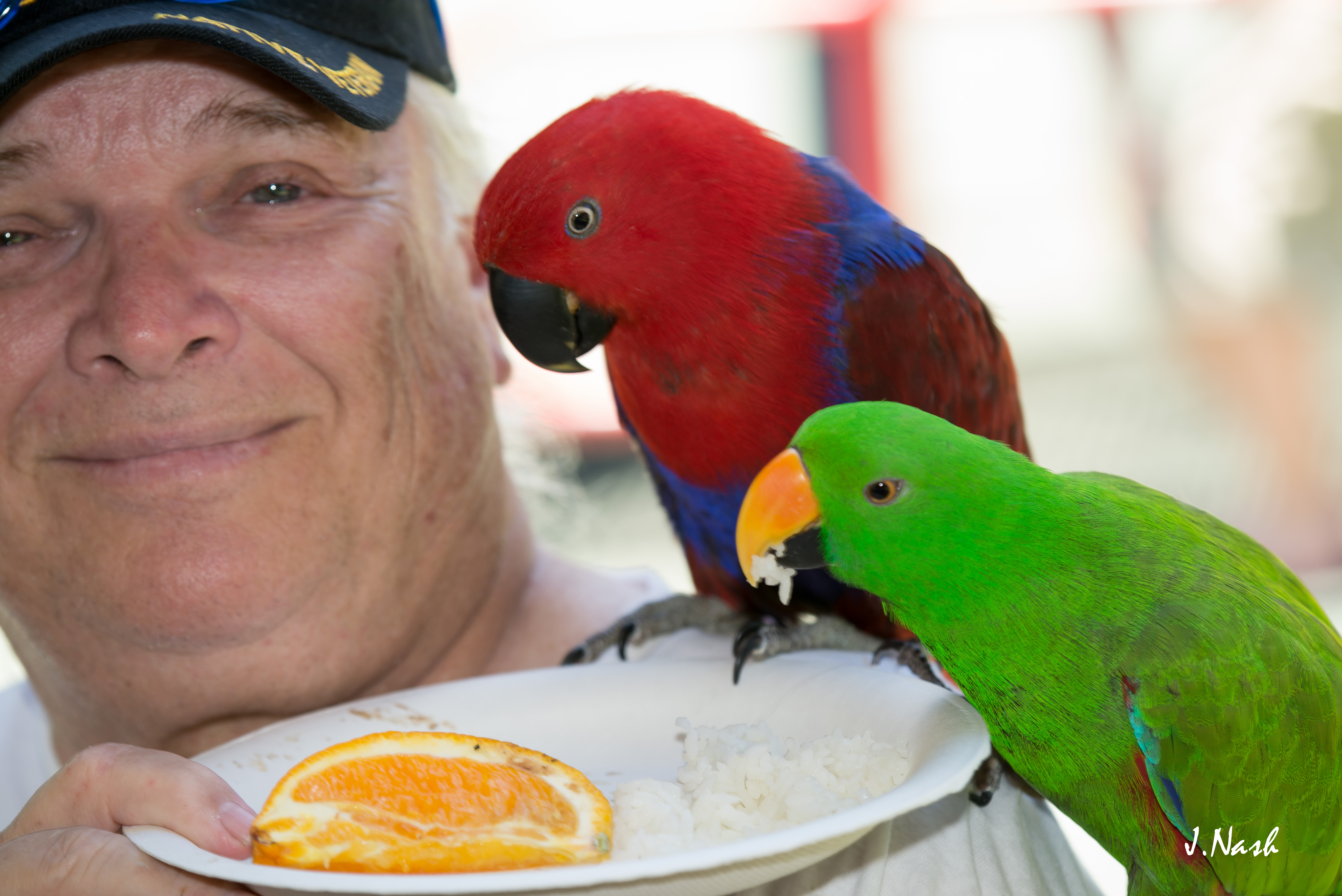
Eclectus ParrotThe Bird That Fooled Science for Centuries
The male is brilliant emerald green. The female is vivid crimson and violet. They share a species, a cage, and sometimes a mate — yet for more than a century, naturalists were convinced they were two entirely different birds.
A Parrot Unlike Any Other
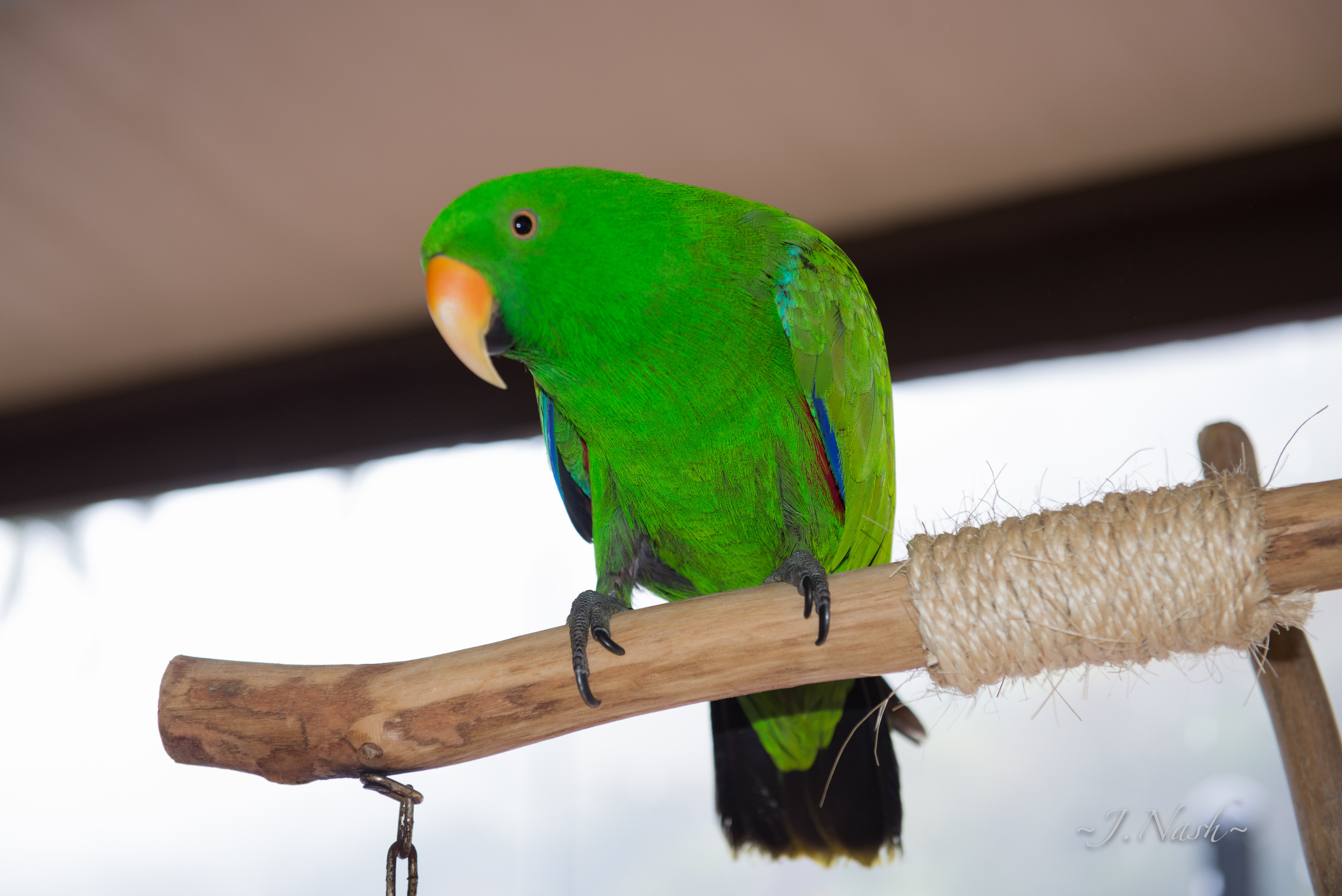
A male Eclectus in full color — the emerald green is unmistakable
The Eclectus Parrot (Eclectus roratus) is native to the Solomon Islands, New Guinea, northeastern Australia, and the Maluku Islands (Moluccas) of Indonesia. It is a stocky, medium-sized parrot — about 35 cm in length — that inhabits tropical rainforest, woodland edges, and mangrove forest across a wide range in the Australasian region.
What immediately sets the Eclectus apart from every other parrot in the world is its extreme sexual dimorphism — the degree to which males and females look different from each other. In most parrot species, the sexes are visually identical or nearly so. In the Eclectus, the difference is so dramatic that European ornithologists who encountered the species in the wild during the 18th and 19th centuries consistently classified the male and female as two separate and unrelated species. It was not until 1874 that the truth was formally established — that these two strikingly different birds were in fact a mated pair of the same species.
The Eclectus is the only extant species in the genus Eclectus. Nine subspecies are recognized, varying in size and the precise shade and extent of coloration — particularly in the female’s red and blue patterning. The Grand Eclectus (E. r. roratus) is the subspecies most commonly encountered in aviculture.
In Hawaiʻi, Eclectus parrots are well represented in our HFFN community. They are prized for their calm temperament, striking beauty, and remarkable talking ability — and they present specific dietary requirements that every owner must understand to keep them healthy.
Two Birds in One Species — The Story That Fooled Science
The sexual dimorphism of the Eclectus Parrot is the most extreme of any parrot species in the world — and one of the most extreme of any bird species. The contrast between male and female is not subtle. It is not a matter of a slightly different shade or a small patch of different color. The male and female Eclectus look like they belong to entirely different families.

Emerald and Candy Corn
Upper mandible orange-yellow fading to yellow at tip · Lower mandible black
The male Eclectus is predominantly brilliant emerald green — a vivid, almost luminous green that seems to glow in natural light. His flanks and underwing coverts are bright red. His primaries are blue. His tail is edged with a narrow band of creamy yellow, and his upper beak is a distinctive orange-yellow fading to yellow at the tip. The lower mandible is black. His irises are orange-red in adults.
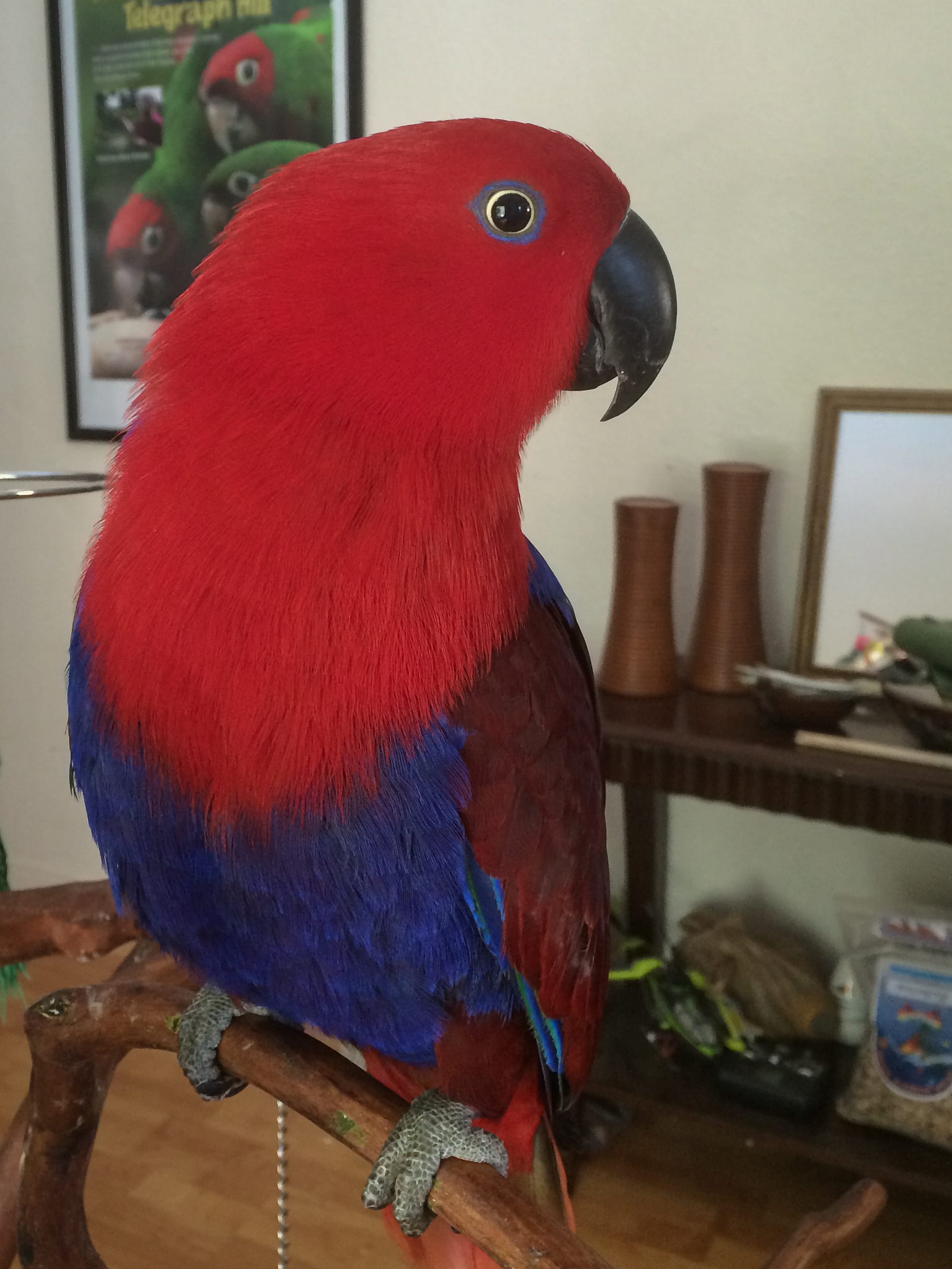
Crimson and Violet
Both upper and lower mandible entirely black · Eye ring red
The female Eclectus is predominantly brilliant red — a deep, rich crimson that darkens to maroon on the back and wings. Her mantle and underwing coverts deepen to a vivid purple-blue, and her wing is edged with mauve-blue. Her tail is edged with yellowish-orange above and tipped with yellow below. Her beak is entirely black. Her eye ring is bright red. She is, by any measure, one of the most visually spectacular parrots in aviculture.
Joseph Forshaw, in his landmark work Parrots of the World, noted that the first European ornithologists to see Eclectus parrots were entirely convinced they were observing two distinct species. It took more than a century of confusion before science confirmed what the birds had known all along.
Male and female together — the contrast that confused scientists for a century
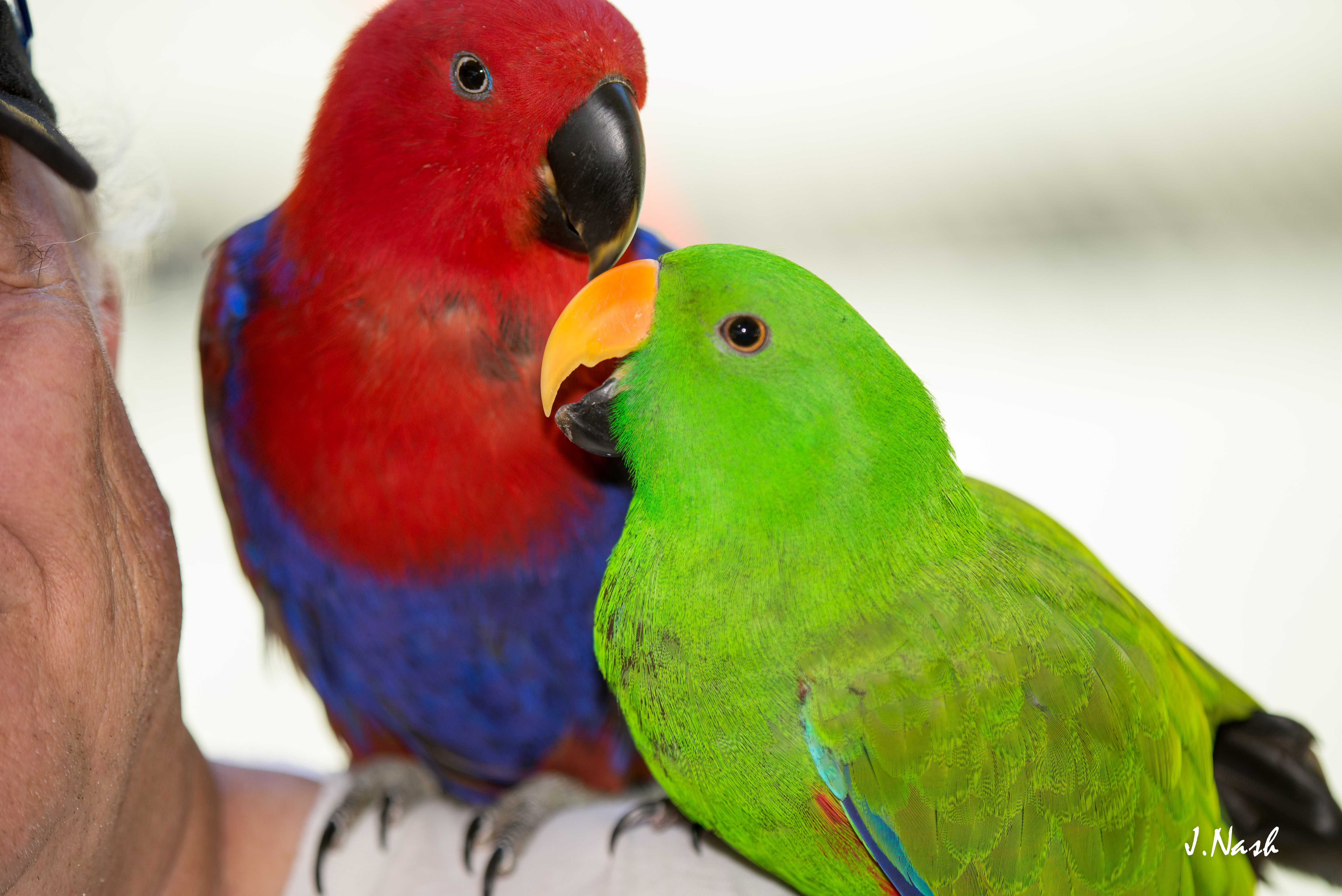
Side by side — same species, entirely different worlds
Nine Subspecies — Each With Its Own Character
Nine subspecies of Eclectus are recognized, varying in body size and in the precise shade and distribution of color — particularly in the female. The differences are most visible in the female’s red and blue patterning and in body size. The Grand Eclectus is the subspecies most commonly kept in aviculture worldwide and most frequently seen in Hawaiʻi.
Grand Eclectus
Eclectus roratus roratus — Moluccas
The largest subspecies and most common in aviculture. The nominate form — the reference subspecies for the species. Female has a broad blue breast band. Most HFFN members who keep Eclectus have Grand Eclectus.
Vosmaeri Eclectus
Eclectus roratus vosmaeri — Northern Maluku Islands
One of the most colorful subspecies — males have particularly vivid, luminous green plumage. Females show more extensive yellow-orange on the tail tip and a broader blue breast band than many other subspecies. Highly sought after in aviculture.
Solomon Islands Eclectus
Eclectus roratus solomonensis — Solomon Islands
A smaller, more slightly built subspecies. The female shows less blue on the breast than the Grand. Well established in aviculture and occasionally seen in Hawaiʻi.
Australian (Macgillivray’s) Eclectus
Eclectus roratus macgillivrayi — Cape York Peninsula, Australia
The largest of all Eclectus subspecies — slightly larger even than the Grand. Native to the rainforests of Queensland’s Cape York Peninsula. Less common in aviculture than the Grand or Vosmaeri.
New Guinea Eclectus
Eclectus roratus biaki and related forms — New Guinea region
Several New Guinea and island subspecies exist with minor variations in size and female coloration. These are less commonly distinguished in aviculture, where most birds are simply sold as “Eclectus” without subspecies documentation.
Sumba Eclectus
Eclectus roratus cornelia — Sumba Island, Indonesia
A distinctive subspecies from the island of Sumba with females showing particularly deep, rich red coloration. Rare in aviculture. The Sumba Island population faces conservation pressure from habitat loss and past trapping.
Gentle, Intelligent — and Surprisingly Sex-Specific

Two males and a female at an HFFN gathering — July 2015
Eclectus parrots are widely regarded as among the most gentle and even-tempered of all the medium-to-large parrot species. They are intelligent, observant, and calm — birds that tend to watch the world carefully before acting, rather than diving in with the physical exuberance of an Amazon or the emotional intensity of a cockatoo. They become deeply integrated into their households and are generally good with children, though they will not tolerate chaotic activity or persistent loud disturbance.
What surprises many Eclectus owners is how different males and females can be in personality — not just in appearance. The behavioral differences between the sexes are real and consistent enough that experienced keepers often describe them as essentially different birds to live with.
♂ Male vs. ♀ Female — Behavioral Differences
Males tend to be more relaxed, easygoing, and social. They are generally more tolerant of handling by multiple people, less territorial, and less hormonally driven. A well-socialized male Eclectus is often described as a remarkably calm, affectionate companion.
Females are typically bolder, more assertive, and more territorial — especially during breeding season or when their nesting instincts are activated. A female Eclectus, even one kept alone without a male, has powerful nesting drives and will seek out dark, enclosed spaces — cupboards, under furniture, inside bags — to claim as nest sites. This behavior must be actively managed. Female Eclectus in a mixed pair are generally the dominant bird. They are wonderful companions but require an owner who understands and respects their more complex emotional landscape.
Both sexes develop extensive vocabularies and are capable of contextually appropriate speech — using words and phrases in situations where they genuinely seem to apply, rather than simply repeating phrases at random. The Eclectus ranks among the better talkers in the parrot world, though they tend to speak more quietly and clearly than the shouting mimicry of some Amazon species.
The Most Diet-Sensitive Parrot in Aviculture
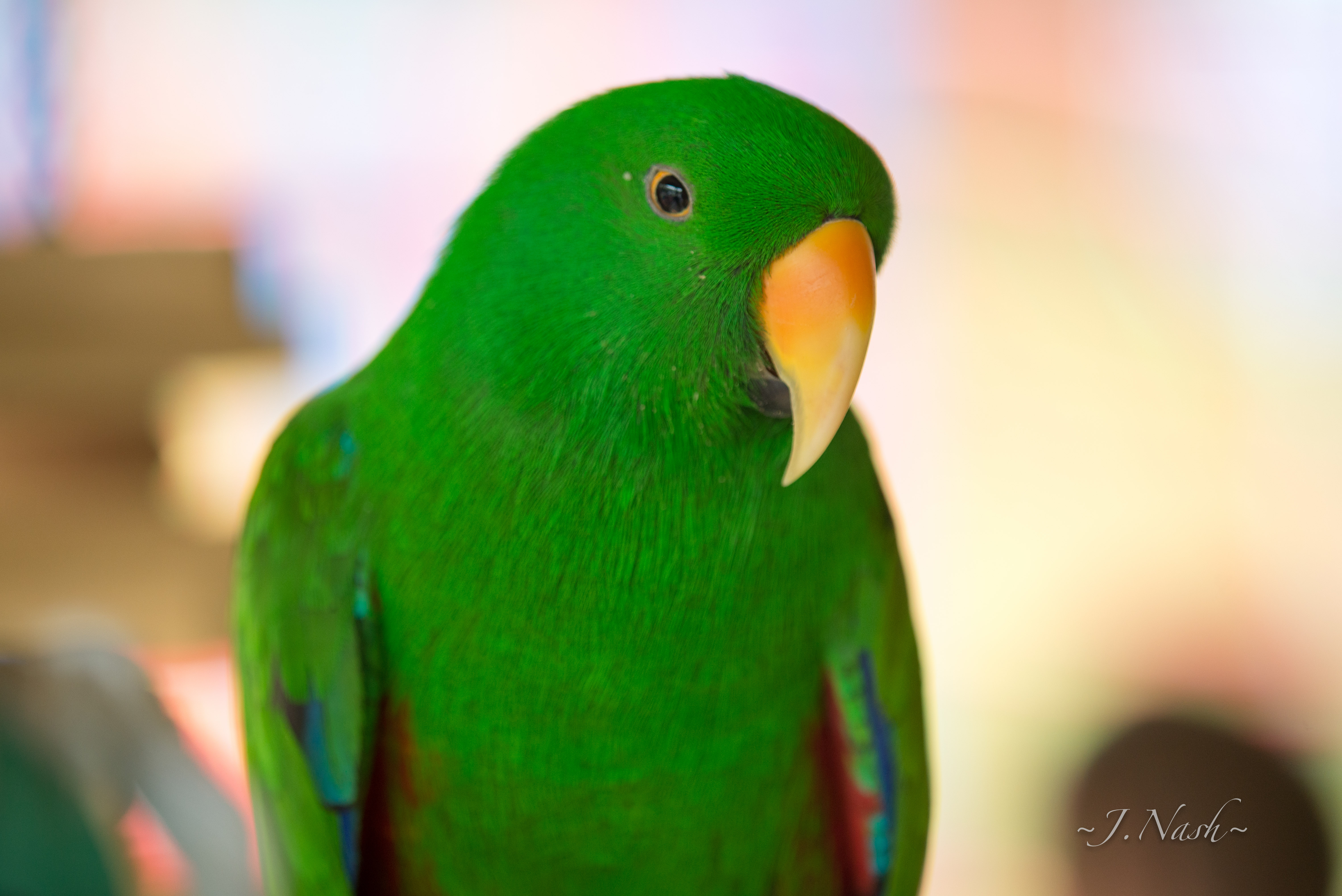
Excellent feather condition — a direct reflection of appropriate diet
Diet is, without question, the most critical and most frequently mismanaged aspect of Eclectus care. More Eclectus parrots suffer and die from improper diet than from any other cause — and the irony is that many of them are being fed with the best intentions by owners who are following standard parrot feeding advice that simply does not apply to this species.
The Eclectus has an unusually long digestive tract compared to most parrots. This means they process food more slowly and extract nutrients more efficiently — which sounds like an advantage, but it also means that they are far more sensitive to dietary imbalances, excesses, and artificial additives. What passes through a macaw or Amazon without incident can cause serious health problems in an Eclectus.
⚠️ The Pellet and Vitamin Problem
Standard avian nutritional advice recommends a pellet-based diet supplemented with fresh foods. For most parrots, this is sound guidance. For Eclectus, heavily fortified commercial pellets — particularly those high in artificial vitamins, synthetic colors, and preservatives — can cause vitamin and mineral toxicities over time. Eclectus metabolize fat-soluble vitamins (A, D, E, K) differently from other parrots, and excess supplementation can cause serious neurological and feather problems. Many experienced Eclectus keepers use pellets sparingly or not at all, relying instead on a varied fresh-food diet to meet nutritional needs. Consult an avian veterinarian with Eclectus experience before settling on a dietary approach.
The ideal Eclectus diet is built primarily around fresh, whole foods — a wide variety of fruits, vegetables, leafy greens, sprouts, cooked grains, and limited nuts and seeds. In Hawaiʻi we are extraordinarily fortunate to have access to many of the fruits that form the backbone of the wild Eclectus diet: papaya, pomegranate, mango, guava, figs, and a wide range of tropical greens. A Hawaiʻi-based Eclectus owner has access to some of the best natural Eclectus nutrition in the world.
Foods to emphasize: Papaya, pomegranate, fig, mango, leafy greens (especially kale, Swiss chard, dandelion greens), sweet potato, carrots, corn, sprouted seeds and legumes, cooked brown rice and quinoa.
Foods to limit or avoid: High-fat seeds and nuts (use sparingly as treats), heavily fortified commercial pellets, any food with artificial colors or preservatives, avocado, chocolate, caffeine, onion, and alcohol — all toxic to parrots.
Feather Condition as a Health Indicator
In the Eclectus, feather quality is a more direct and reliable indicator of overall health and diet adequacy than in almost any other parrot species. A healthy, well-nourished Eclectus has smooth, glossy, perfectly formed feathers with vivid color. Stress bars, frayed feathers, dull coloration, or abnormal feather growth are early warning signs that something is wrong — most often diet. If your Eclectus’s feathers look less than perfect, diet should be the first thing you examine, and an avian vet visit should follow promptly.
Eclectus in Our Community
These photographs were taken at HFFN gatherings on Oʻahu — real birds belonging to real members of our community. The Eclectus is one of the most photographed birds at our meetings, and it is easy to understand why.

Two males, one female · July 2015
Male and female · July 2015
A pair at rest · July 2015
Space, Enrichment, and Managing Nesting Instincts
Eclectus parrots are active and need a generously sized cage — at minimum 24 × 36 × 48 inches for a single bird, though larger is always better. They enjoy climbing, chewing, and foraging, and benefit from a variety of natural wood perches, foraging toys, and soft wood items to shred. Unlike some parrot species, Eclectus are not typically destructive in a dramatic way — they tend to be more methodical explorers than aggressive chewers — but enrichment is still essential for psychological wellbeing.
Out-of-cage time should be daily and supervised. Eclectus enjoy interaction but also appreciate quiet time — they are not birds that demand constant entertainment. They are good at occupying themselves with toys and foraging activities, which makes them somewhat more manageable than high-energy species like caiques or lorikeets.
Bathing is important for feather maintenance and should be offered regularly — a mist spray or shallow bath several times per week. In Hawaiʻi’s warm climate, daily misting is practical and beneficial year-round. Feather condition in Eclectus is closely linked to both diet and humidity — birds in drier environments may need more frequent bathing to maintain optimal feather quality.
⚠️ Managing Female Nesting Behavior
Female Eclectus — even those kept alone without a male companion — have powerful, persistent nesting instincts. They will actively seek out dark, enclosed spaces in the home to claim as nest sites: inside cupboards, under furniture, in bags, behind appliances. This behavior can become obsessive and is associated with increased territorial aggression. The management strategy recommended by most experienced Eclectus keepers is to deny access to dark enclosed spaces entirely rather than allowing the behavior to establish. A female who has found a nest site is significantly harder to manage than one who has never had the opportunity. Keep closets closed, bags out of reach, and furniture gaps blocked.
Common Conditions to Watch For
A well-cared-for Eclectus on an appropriate diet can live 30–50 years or more. Health problems in this species are very often diet-related and therefore preventable. The following conditions appear most frequently:
- Vitamin A deficiency (seed-heavy diets)
- Vitamin/mineral toxicity (over-supplementation)
- Feather-destructive behavior
- Toe-tapping and wing-flipping (neurological — diet-related)
- Psittacosis (Chlamydia psittaci)
- Psittacine Beak and Feather Disease (PBFD)
- Proventricular Dilatation Disease (PDD)
- Aspergillosis (fungal infection)
- Lipomas (fatty tumors — diet-related)
- Reproductive problems in females
- Heavy metal toxicity (zinc, lead)
- Respiratory infections
Toe-tapping and wing-flipping — rhythmic, involuntary movements of the toes or wings — are neurological symptoms seen almost exclusively in Eclectus and are strongly associated with dietary problems, particularly vitamin B deficiency or toxicity from over-supplementation. If you observe these behaviors in your Eclectus, consult an avian vet immediately and review the diet. Annual avian veterinary examinations with bloodwork are strongly recommended.
Common in the Wild, Vulnerable in Places
The Eclectus Parrot as a species maintains large wild populations across much of its range and is not considered globally threatened. However, several island subspecies face significant pressure from habitat loss and, historically, from capture for the pet trade. The Sumba Eclectus (E. r. cornelia), restricted to the island of Sumba in Indonesia, is of conservation concern. The extinct Oceanic Eclectus (Eclectus infectus), known from fossil remains in Tonga and Vanuatu, is a sobering reminder of what human-caused habitat loss can permanently remove from the world.
The species is listed on CITES Appendix II — international trade is regulated but not prohibited. All Eclectus in the United States pet trade are required to be captive-bred. Wild-caught importation has been prohibited since the Wild Bird Conservation Act of 1992.
Their bright feathers have historically been used as decorations by indigenous peoples in New Guinea, and the birds are still occasionally viewed as agricultural pests in areas where large flocks raid fruit crops — a complex dynamic that complicates conservation efforts in some parts of their range.
Eclectus in Rescue — What to Expect
Eclectus parrots come into rescue most commonly for two reasons: owners who were not prepared for the specialized dietary requirements of the species, and female birds whose nesting behavior became unmanageable in a household that did not understand how to address it. Both are entirely preventable with the right information — which is exactly why this page exists.
A rescue Eclectus may arrive with feather damage, dietary deficiencies, or behavioral challenges accumulated from years of inadequate care. With appropriate diet, enrichment, and patient handling, most Eclectus respond remarkably well to improved conditions — their feathers can recover, their behavior can stabilize, and their remarkable personalities can re-emerge.
HFFN places Eclectus through our careful, relationship-based adoption process. If you are interested in adopting an Eclectus, please come to a meeting, familiarize yourself with the species’ dietary and behavioral requirements, and be prepared to have an honest conversation with us about your experience level and your household situation.